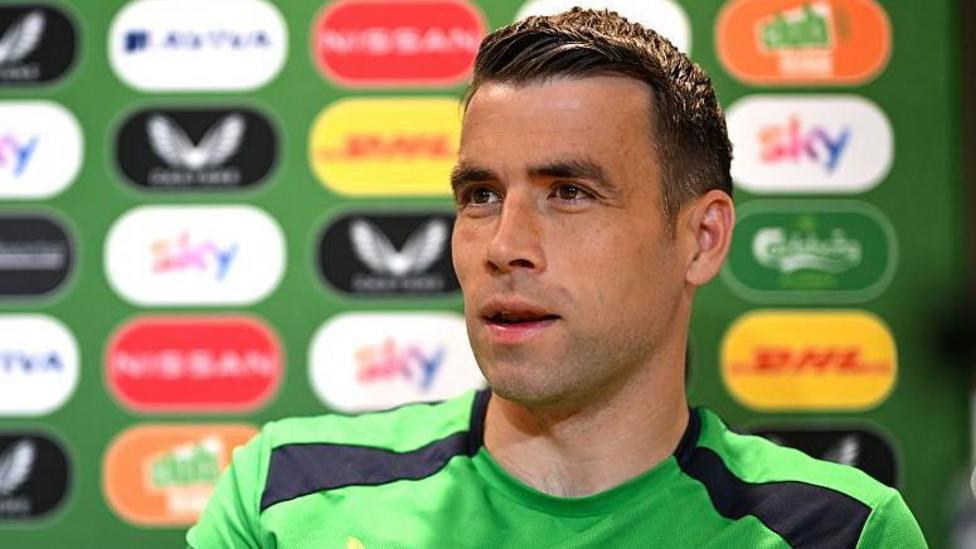
Republic of Ireland captain Seamus Coleman hits out at the FAI and UEFA for putting players in an "uncomfortable" position over upcoming Nations League games.
Seamus Coleman has never been one to shy away from his responsibilities as a leader, but the veteran defender has reached his limit regarding the intersection of international football and global politics. Ahead of the Republic of Ireland's friendly against Qatar, the captain stood before the media not to discuss tactical shifts or defensive lines, but to express a profound frustration that the burden of the nation’s moral conscience has been placed on the shoulders of his squad. Coleman’s message was clear: the decision of whether or not to face Israel in the Nations League is a matter for administrators in the corridors of power, not for young men in tracksuits.
The controversy stems from Ireland's scheduled fixtures against Israel on September 27 and October 4. As the humanitarian crisis in Gaza continues to dominate the headlines and spark protests outside the Dáil, the pressure on the Football Association of Ireland (FAI) to implement a boycott has reached a fever pitch. Yet, while the governing body cites "serious consequences" from UEFA as a reason to proceed, the players find themselves caught in the crossfire of a public debate they feel ill-equipped to resolve. Coleman’s voice, steady but heavy with emotion, highlighted a growing rift between the human feelings of the dressing room and the bureaucratic obligations of the association.
The Administrative Failure to Protect the Squad
Heimir Hallgrimsson’s tenure as Ireland manager has barely begun, and already he is navigating a political minefield that has little to do with the pitch. The manager has described the situation as "unfair," a sentiment Coleman echoed with significant bite. At 37, Coleman understands the weight of the armband better than most, but he argued that his younger teammates—some barely in their twenties—should not be the ones forced to adjudicate on international law and human rights. By failing to take a definitive stance or reach an agreement with UEFA earlier, the FAI has effectively left the players to act as the face of an impossible dilemma.
The FAI’s CEO, David Courell, has been frank about the governing body’s position, stating they have "no choice" but to play. The fear of heavy sanctions, which could include expulsion from future tournaments or massive financial penalties, has paralyzed the association’s ability to act on the public sentiment sweeping the country. However, this pragmatic approach does little to alleviate the "uncomfortable" reality for the players, who must now prepare for a football match against a backdrop of protest and tragedy. Coleman’s insistence that he "knows the difference between right and wrong" suggests that while the players will follow orders, their hearts are far from the game.
Protests at the Dáil and the 'Stop The Game' Campaign
The movement for a boycott is not a fringe concern; it has become a centralized campaign involving the Ireland Palestine Solidarity Campaign and the newly formed 'Irish Sport For Palestine.' On Tuesday, the gates of the Irish parliament were the site of a significant protest, with activists calling for the FAI to show the same moral courage that the Irish government has often displayed on the international stage. The 'Stop The Game' campaign points to what it describes as systematic breaches of FIFA and UEFA statutes, arguing that the inclusion of Israeli teams is a violation of the sporting principles these organizations claim to uphold.
For the players, these protests are impossible to ignore. They represent the people of Ireland, and when those people are shouting for a stand to be taken, the silence from the governing bodies becomes deafening. Coleman noted that as representatives of the public, the players must take the nation's opinion into account, yet they are simultaneously bound by professional contracts and the threat of career-altering sanctions. It is a dual loyalty that is tearing at the fabric of the squad’s preparation, turning a football tournament into a weekly referendum on ethics.
The Individual Choice and the Captain’s Support
One of the most striking developments in this saga has been the admission from Nathan Collins that individual players might choose to boycott the games on their own terms. Collins made it clear that the squad would stand behind anyone who felt their conscience prevented them from taking the pitch. This marks a significant shift in the traditional "team first" mentality of international football, acknowledging that some issues are too large to be subsumed by the collective goals of a Nations League group. It places a massive amount of pressure on individuals to make a public moral stand, a move that could have long-lasting effects on their professional standings.
Coleman, as a husband and a father, spoke to the human side of the conflict that transcends the sport. He described the situation in the Middle East as "awful" and "extremely sad," words that reflect the mood of a dressing room that is far more engaged with the world around it than often credited. The difficulty for these players is that they are being asked to compartmentalize these emotions in favor of a football match that many in their own country believe should not happen. The captain’s support for individual choice is a brave admission that the game is not, in fact, more important than the issues at hand.
The Road to a Neutral Venue
While the return fixture is set for Dublin on October 4—a date that promises to be one of the most politically charged in the history of the Aviva Stadium—the first meeting is expected to take place at a neutral venue. The search for a host city that is willing and able to provide the necessary security for such a high-risk fixture only adds to the sense of unease. For the Irish players, the logistical uncertainty is a minor distraction compared to the ethical weight of the event. They are preparing for a match that will be played under a cloud, with every touch of the ball scrutinized by those who believe the game itself is an act of complicity.
The FAI’s stance remains that the games will proceed, but the damage to the relationship between the governing body and the playing squad may already be done. By allowing the controversy to "land on the toes" of the players, as Coleman put it, the association has abdicated its role as a shield for the team. Whether the games are eventually played or a last-minute intervention occurs, the autumn fixtures have already become a stain on the Nations League calendar for Ireland, leaving a group of footballers to navigate a path that their leaders were too afraid to tread.
A Captain’s Final Word on a Divided Future
As Seamus Coleman nears the end of his illustrious international career, he likely imagined his final years would be spent mentoring the next generation on the nuances of the game. Instead, he finds himself acting as a spokesperson for a squad grappling with their place in a broken world. His blunt assessment that the players should not be in this position is a stinging rebuke to those who run the game. It is a reminder that while football can be a powerful tool for unity, it can also be a source of profound discomfort when it ignores the reality of the people who play it.
The upcoming weeks will test the resolve of everyone involved in Irish football. The FAI will have to manage a public relations nightmare, the manager will have to keep his players focused, and the players themselves will have to decide what kind of representatives they want to be. For Seamus Coleman, the badge on his chest is a source of pride, but the burden that has come with it this autumn is one he never asked for and one he believes the sport's governors should have had the courage to carry themselves.
Keep up with more football news on MATCHLINE as the Republic of Ireland navigates this challenging international break.