Jamie McGrath warns of 'heating up' atmosphere following pro-Palestine protests during the Republic of Ireland's friendly victory over Qatar.
The Republic of Ireland’s narrow 1-0 victory over Qatar on Thursday evening was supposed to be a straightforward exercise in tactical fine-tuning, but the final whistle at the Aviva Stadium has only amplified the geopolitical tremors felt within the squad. As Nathan Collins' early header secured the win, the real story unfolded not on the scoresheet, but in the stands and on the turf, where home supporters twice disrupted play by launching tennis balls decorated with the Palestinian flag onto the pitch. For midfielder Jamie McGrath, these scenes were merely a prologue to a summer of mounting pressure and unavoidable controversy as the national team prepares for its high-stakes Nations League encounters with Israel.
Protests at the Aviva Stadium
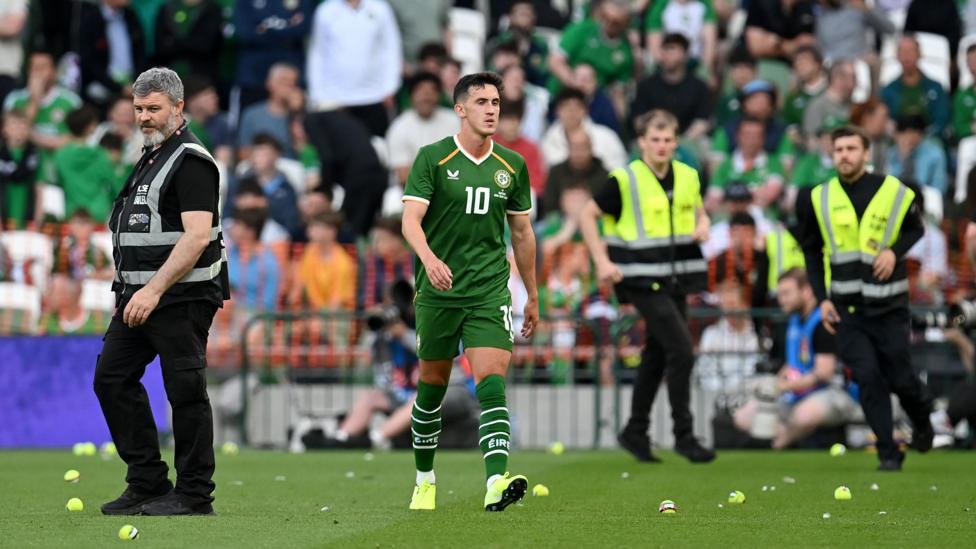
The match against Qatar was punctuated by moments of clear domestic dissent, reflecting a growing segment of the Irish public that remains deeply uneasy with the scheduled fixtures against Israel. Security at the Aviva Stadium was forced into action twice during the first half as the flow of the game was halted to clear tennis balls from the playing surface. These were not random acts of hooliganism, but targeted symbolic protests, with the balls carrying the colors of the Palestinian flag and accompanying reports from the stadium suggesting several individuals were swiftly escorted from the grounds by staff. It was a visual manifestation of a movement that has already seen the Ireland Palestine Solidarity Campaign take their grievances to the steps of the Dáil this week.
Jamie McGrath, speaking with remarkable candor after the match, acknowledged that the intensity of this backlash is unlikely to dissipate. The Aberdeen midfielder admitted that the squad is fully aware of the public sentiment, and he expects the narrative to become even more volatile as the neutral venue fixture on September 27 and the return leg in Dublin on October 4 approach. While the players would prefer to keep their focus entirely on the pitch, McGrath noted that the unique nature of this scenario makes such a separation nearly impossible, particularly when the external pressure begins to filter into the matchday environment itself.
The Leadership Stance and Squad Sentiment
The current climate has placed the senior leadership of the team in a delicate position, caught between their professional obligations and the strong political convictions of their supporters. Seamus Coleman, the veteran captain and emotional core of the side, recently suggested that the burden of navigating this controversy should have been handled by those in the higher echelons of the Football Association of Ireland (FAI) rather than the players themselves. McGrath echoed this sentiment, praising Coleman’s honesty while admitting that the squad feels increasingly exposed to a situation they did not create and cannot easily resolve.
Within the dressing room, the conversation has shifted from purely tactical analysis to the ethics of participation. While the FAI has confirmed that the games will proceed as planned, individual players are grappling with the potential for personal boycotts. Nathan Collins has already stated that the group would not ostracize or stand against any teammate who felt compelled by their conscience to step away from these specific matches. This collective solidarity suggests a squad that is deeply reflective, even as they are being pushed toward a confrontation with global politics that few footballers ever have to face in their careers.
The FAI and the Threat of Sanctions
For the governing body, the decision to play the games is presented not as a political endorsement, but as a matter of institutional survival. FAI Chief Executive David Courell has been clear that the association finds itself with no real alternative, citing the risk of "serious consequences" from international governing bodies should they choose to boycott the Nations League fixtures. These sanctions could range from heavy financial penalties to suspension from future tournaments, a scenario that an organization still recovering from historical financial instability simply cannot afford to entertain. It is a pragmatic, if unpopular, defense that highlights the powerlessness of national associations when faced with rigid UEFA and FIFA mandates.
The FAI's position is that the sporting calendar must remain sacrosanct, yet the protests at the Aviva Stadium prove that the public does not view football as a vacuum. By insisting that the games must go ahead, the association has effectively left the manager and the players to act as the public face of a policy that is being heavily scrutinized by domestic political groups. This disconnect between the boardroom and the terraces is likely to define the buildup to the September international window, with McGrath and his teammates bracing for an atmosphere that will be anything but neutral.
Managerial Pragmatism vs Public Outcry
Heimir Hallgrimsson, the Republic of Ireland manager, finds himself in the unenviable position of trying to coach a team through a hurricane of external noise. His reaction to the Qatar game was one of stoic pragmatism, suggesting that if protesters intended to disrupt the sporting spectacle, the team would simply have to endure it. However, this stance does little to address the underlying tension within the fan base. Hallgrimsson is tasked with building a cohesive unit for the Nations League, but he is doing so against a backdrop where the very presence of the opposition is a source of nationwide debate.
The manager's focus is understandably on performance, but even he cannot ignore the reality that the upcoming games against Israel will be the most scrutinized of his tenure. The technical staff must now prepare not just for the tactical threats posed by their opponents, but for the logistical challenges of playing in a high-tension neutral venue and the potential for even more significant disruptions when the return leg arrives in Dublin. It is a test of managerial temperament as much as it is a test of tactical acumen.
A Resolution Taken Out of Players' Hands
As the controversy "heats up," there is a palpable sense among the players that the final decision may eventually be taken out of their hands by governing bodies or security assessments. McGrath admitted as much, noting that while the team has discussed the situation, the ultimate resolution might lie with the "powers above." The midfielder's hope that these leaders can find a way to use the situation for the "greater good" reflects a desperate desire for a path forward that doesn't involve the players being used as political pawns.
The next few months will determine whether the FAI can successfully navigate this minefield without causing a permanent rift with its supporters. For now, the players remain in a state of limbo, preparing for matches that many in their own country believe should not take place. The tennis balls at the Aviva Stadium were a warning shot; the real challenge for Irish football lies in how it responds when the stakes are no longer just about a friendly header, but about the very soul of the national team's relationship with its people. more football news on MATCHLINE