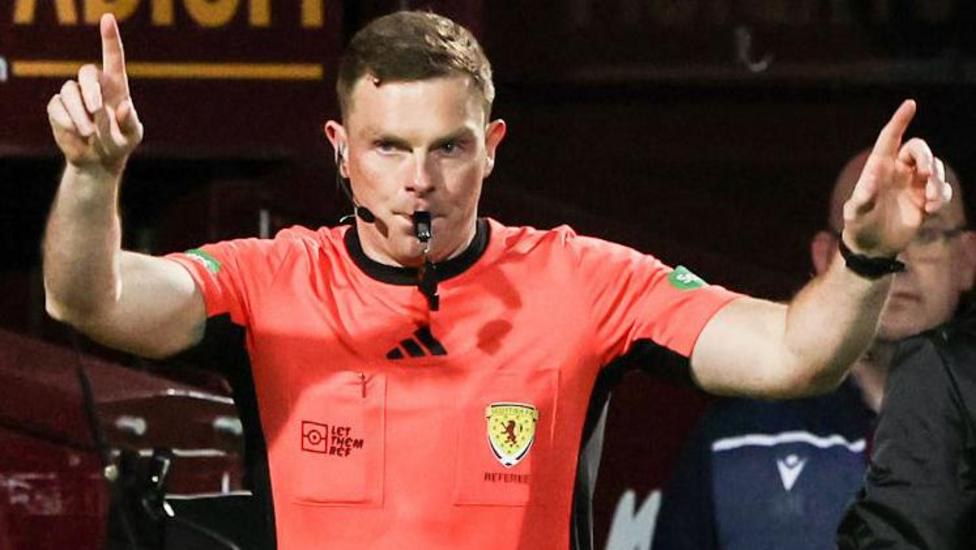
Scottish football reaches a dark milestone as official John Beaton requires police surveillance following a toxic fallout from midweek refereeing decisions.
Scottish football is no stranger to the white-heat of a title race, but the current campaign has crossed a dangerous line into the territory of personal safety and criminal intimidation. The Scottish FA has confirmed that referee John Beaton and his family were placed under police surveillance following the leak of his personal contact details online. It is a sobering development that underscores the terrifying reality of modern officiating, where a subjective call on the pitch can lead to a credible threat at a person's front door.
The catalyst for this escalation was a controversial penalty award during Celtic's 3-2 victory over Motherwell at Fir Park. In a season defined by razor-thin margins at the top of the Scottish Premiership, every whistle is scrutinized with a level of intensity that often veers into the irrational. The SFA's statement was a blistering critique of the environment surrounding the game, calling for immediate perspective before an unthinkable tragedy occurs. The governing body is now pleading for a return to civility as the season reaches its final, explosive matches.
The Toxic Environment of Fir Park and Beyond
The incident that sparked the latest wave of vitriol occurred late in Wednesday’s clash at Motherwell. With the scores level at 2-2, a high ball saw Sam Nicholson and Auston Trusty collide. Following a VAR intervention, John Beaton judged that Nicholson had committed a handball, awarding a penalty that Kelechi Iheanacho subsequently converted. While the decision was arguably correct under the current interpretation of the rules, the reaction from the Motherwell camp and sections of the media was instantaneous and inflammatory.
Motherwell manager Derek McInnes did not hold back, describing the decision as disgusting and suggesting his team was fighting against an unfair system. In the pressurized vacuum of a title chase, such comments act as fuel for an already raging fire. The SFA argues that these knee-jerk reactions from managers, combined with a hysterical media narrative, create a climate where fans feel emboldened to take their frustrations beyond the stadium gates. The transition from vocal disagreement to digital vigilantism has become alarmingly swift.
What followed was the doxing of Beaton, with his private information shared across social media platforms. For an official to have his home life compromised because of a handball decision is a damning indictment of the current state of the game. The SFA thanked Police Scotland for their swift intervention, but the fact that such a response was necessary at all highlights a systemic failure in the culture of Scottish football. Officials are being treated not as impartial arbiters, but as targets for a collective's seasonal frustrations.
The Scourge of Scapegoating and Hysteria
The SFA’s statement was notable for its bluntness, refusing to hide behind the usual corporate platitudes. They identified a specific chain of culpability, starting with media pundits and extending to official supporters' groups and club staff. By constantly framing every error or subjective call as a conspiracy or an act of incompetence, these stakeholders are contributing to an atmosphere of fear. The national association’s message was clear: those who stir the pot cannot act surprised when it boils over.
One of the most concerning aspects of this trend is the impact on future refereeing recruitment. Who would choose to pick up a whistle when the occupational hazards include police protection for your children at school? The SFA pointed out that this environment is actively harming their ability to provide officials at all levels of the game. If the top tier is this toxic, the trickle-down effect on grassroots football is devastating. We are witnessing the slow-motion dismantling of the sport’s essential infrastructure.
The governing body also drew a necessary parallel between the errors made by officials and those made by the participants. Managers pick the wrong tactics, strikers miss open goals, and goalkeepers fumble basic shots. These are accepted as part of the game’s human fabric. Yet, a refereeing mistake is often treated as a moral failing or a deliberate act of sabotage. This lack of parity in criticism is what the SFA describes as an inconvenient truth that the Scottish game must finally confront.
Legislative Changes and the Path Forward
In response to the threats against Beaton, the Scottish FA is now seeking to strengthen its rules to better protect officials. This likely means harsher punishments for clubs whose staff or players make inflammatory comments in post-match interviews. It could also involve a more robust approach to social media monitoring and working closer with law enforcement to prosecute those who engage in online harassment. However, rules can only do so much; the real change must be cultural.
There is a call for official supporters' groups to take more responsibility for the behavior of their members. When clubs release statements that question the integrity of the league’s officials, they are providing a blueprint for the fans to follow. The SFA is urging these organizations to support their proposals for tougher regulations rather than trying to water them down for the sake of self-preservation. The safety of match officials must be viewed as a non-negotiable requirement for the continuation of professional football.
The upcoming fixtures, including a massive clash between Celtic and Hearts, will be the first test of this new plea for calm. The eyes of the country will be on the officials, but perhaps more importantly, they will be on the reaction of the stands and the dugouts. If the toxicity continues unabated, the SFA may find itself forced into even more drastic measures to ensure the wellbeing of its staff. The beautiful game cannot thrive when its facilitators are living in a state of alarm.
Perspective in the Title Race Finale
As we approach the final whistle of the season, the SFA is demanding a return to sporting perspective. A league title is a monumental achievement, but it is not worth the safety of a human being. The association wants the focus to return to the skill of the players and the tactical battles on the pitch, rather than the perceived injustices of the VAR room. They are asking for a ceasefire in the war of words that has dominated the back pages for months.
John Beaton’s ordeal is not an isolated incident, but it must be the tipping point. The SFA's refusal to allow this to become the norm is a line in the sand. For too long, the abuse of referees has been dismissed as part of the theater of football. By bringing the police into the conversation, the authorities are reminding everyone that the law of the land does not stop at the stadium turnstiles. Real-world consequences must follow real-world threats.
The hope is that by the time the next season kicks off, a new set of standards will be in place. This will require the cooperation of every club in the SPFL and a commitment from the media to move away from sensationalist framing. Until then, the image of a referee sitting in a locked house under police surveillance remains a dark stain on the Scottish game. It is a moment that should force every fan, player, and pundit to look in the mirror and ask what role they played in creating this crisis. more football news on MATCHLINE