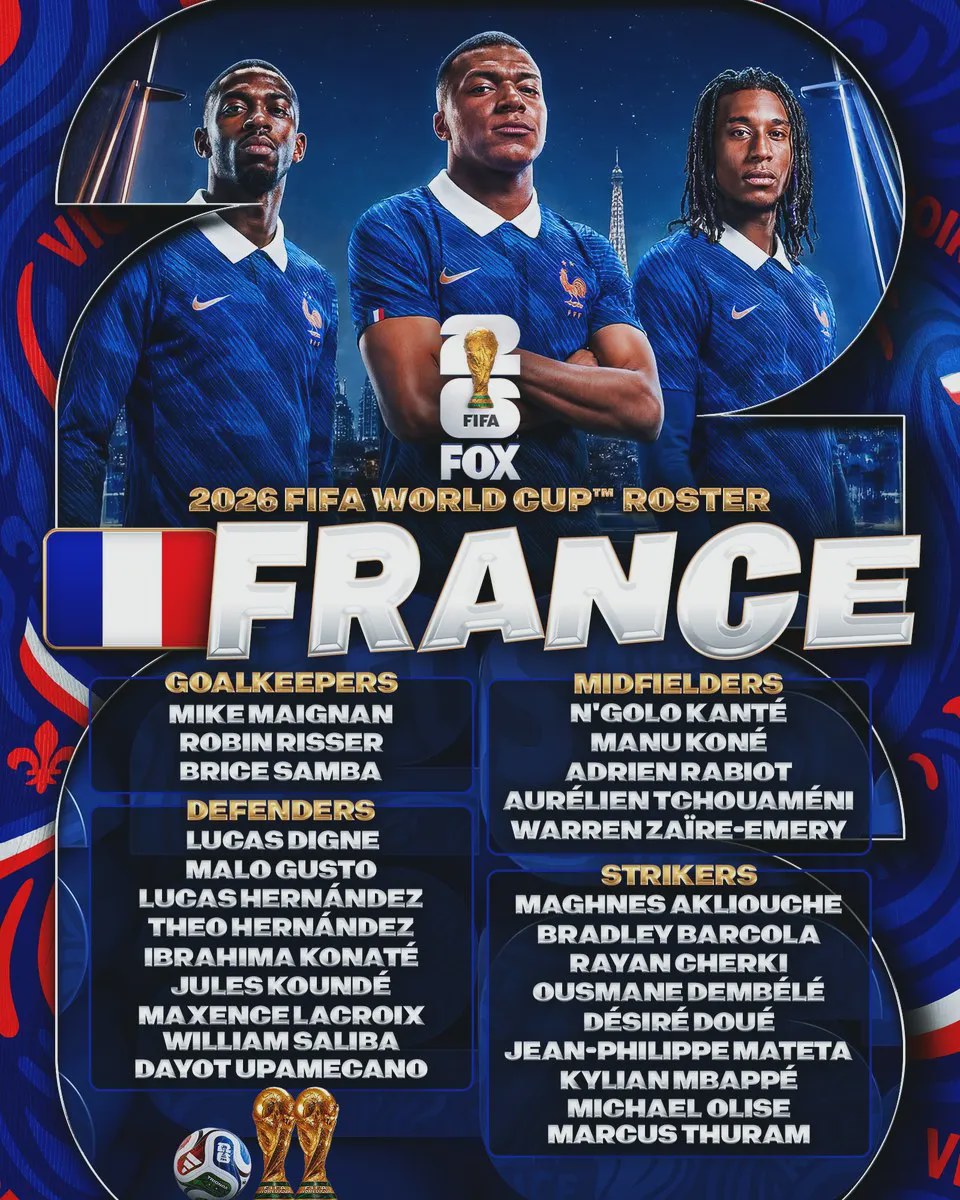
Didier Deschamps names his 26-man roster for the 2026 World Cup, featuring surprise call-up Robin Risser but no place for Real Madrid's Eduardo Camavinga.
The announcement of a French World Cup squad is rarely a quiet affair, and Didier Deschamps has ensured his final act as national team manager is punctuated by a blend of calculated risks and ruthless exclusions. As Les Bleus prepare to descend upon North America for the 2026 showpiece, the veteran coach has prioritized immediate form over reputation, a philosophy that has claimed its most high-profile victim in Real Madrid’s Eduardo Camavinga. In a roster brimming with Ballon d’Or pedigree and surging youthful energy, Deschamps is banking on a new generation to deliver a third star to the French jersey. The inclusion of Lens goalkeeper Robin Risser, the newly crowned best keeper in Ligue 1, serves as the headline shock, signaling a meritocratic shift in a squad that has often relied on a more established hierarchy.
The Risser Revolution and the Goalkeeping Shake-up
In the wake of Hugo Lloris's international retirement, the French goal has been a site of significant transition, but few predicted the meteoric rise of Robin Risser. The Lens shot-stopper has been nothing short of a revelation this season, anchoring the second-best defense in France and earning a place in the squad as the designated number three. Risser’s selection is a direct reward for his consistency and shot-stopping heroics, which saw him scoop the Ligue 1 Goalkeeper of the Year award just days ago. For the young man from Lens, the call-up is the realization of a dream he once thought was years away. His presence in the squad provides a fresh dynamic behind the established Mike Maignan and Brice Samba, offering Deschamps a reliable alternative should injury or suspension strike.
Conversely, the goalkeeping department also highlights Deschamps' ruthless streak. Lucas Chevalier, once considered the heir apparent to the number one jersey, finds himself in the international wilderness. Having lost his starting berth at Paris Saint-Germain to Matvey Safonov and failing to log competitive minutes since late January, Chevalier has been omitted on the grounds of "sporting performance." Deschamps was blunt in his assessment, noting that while he understands Chevalier's disappointment, the lack of playing time made his selection impossible. This decision underscores the manager's refusal to carry passengers, regardless of their past contributions or perceived potential.
The Midfield Conundrum and the Camavinga Snub
The omission of Eduardo Camavinga is the decision that will ignite the most debate across the bistros of Paris and the boardrooms of Madrid. The Real Madrid midfielder, despite his versatility and experience in high-pressure Champions League fixtures, has been left out of the 26-man list. Deschamps has opted for a midfield unit that emphasizes physical presence and tactical discipline, led by the evergreen N'Golo Kanté and the emerging powerhouse Manu Koné. While Camavinga’s technical ability is unquestioned, the manager seems to have favored players who have maintained a higher level of week-in, week-out consistency during the domestic campaign. The inclusion of Warren Zaïre-Emery further illustrates this shift toward the next cycle of French talent.
This midfield selection suggests a tactical pivot for the 2026 tournament. With Aurelien Tchouaméni and Adrien Rabiot likely to form the core of the engine room, Deschamps is looking for a blend of defensive solidity and the ability to transition quickly to an explosive front line. The absence of Camavinga removes a creative spark but potentially adds a level of structural rigidity that Deschamps has historically favored in tournament knockout stages. It is a gamble that puts immense pressure on the likes of Koné and Zaïre-Emery to prove they can replicate their club form on the world’s grandest stage.
A Forward Line of Fearsome Proportions
If there is one area where France remains the envy of the footballing world, it is in their attacking reservoir. The list of forwards reads like a 'Who's Who' of global superstars and rising prodigies. Kylian Mbappé remains the undisputed talisman, but he is now flanked by Ballon d’Or winner Ousmane Dembélé and a supporting cast that includes Michael Olise and Rayan Cherki. The inclusion of Jean-Philippe Mateta over Randal Kolo Muani is perhaps the most intriguing selection in the final third. Mateta’s prolific form for Crystal Palace has earned him the nod over the Tottenham striker, who famously came inches away from becoming a national hero in the 2022 final against Argentina.
Deschamps appears to be leaning toward players who can offer a more physical, direct threat in the North American heat. Mateta’s ability to lead the line and act as a focal point provides a different dimension to the fluid, drifting movements of Mbappé and Dembélé. The manager has also integrated a wave of exciting youngsters like Désiré Doué and Maghnes Akliouche, ensuring that the French attack is not just potent, but unpredictable. This blend of seasoned winners and hungry debutants creates a depth chart that will allow Deschamps to rotate aggressively throughout a grueling 104-match tournament structure.
Deschamps’ Last Dance and the Zidane Shadow
This tournament marks the end of an era for French football. Didier Deschamps has confirmed that 2026 will be his final act as national team coach, concluding a fourteen-year reign that has seen France reach the pinnacle of the sport. His legacy is already secured, but the desire to sign off with a second World Cup title is palpable. The manager admitted to a "special feeling" during the squad announcement, acknowledging that many of his daily routines are now being performed for the final time. This emotional weight could serve as a powerful motivator for a squad that clearly holds immense respect for their long-serving leader.
Waiting in the wings, however, is the inevitable specter of Zinedine Zidane. The former France great is widely expected to take the reins following the tournament, and his shadow looms large over every tactical decision Deschamps makes. While Zidane has been out of the dugout since his second spell at Real Madrid, his link to the national team remains the most discussed topic in French sports media. For now, Deschamps is focused on the immediate task: navigating a Group I that includes Senegal, Iraq, and Norway. He knows that his final roster must not only be talented but cohesive enough to withstand the scrutiny and pressure that comes with being the tournament favorites.
Defensive Depth and the Road to New Jersey
While the attackers grab the limelight, the French defense remains a formidable wall. Ibrahima Konaté, William Saliba, and Dayot Upamecano represent some of the finest central defensive talent in Europe, providing a foundation of pace and power. The inclusion of Maxence Lacroix adds further depth, while the Hernandez brothers, Théo and Lucas, offer familiarity and elite quality on the flanks. This defensive stability will be crucial as France navigates the expanded format of the 2026 World Cup, where consistency over seven or eight matches will be the key to reaching the final at the New York New Jersey Stadium.
As the French squad prepares to depart for their training camp, the narrative is firmly established. It is a team of immense talent, shorn of some familiar faces but invigorated by new blood. Deschamps has made his choices, and whether the omission of Camavinga proves to be a masterstroke or a mistake will be determined on the pitches of Canada, Mexico, and the United States. For Les Bleus, the mission is clear: return to the summit of world football and give their greatest manager the farewell his storied career deserves. more football news on MATCHLINE