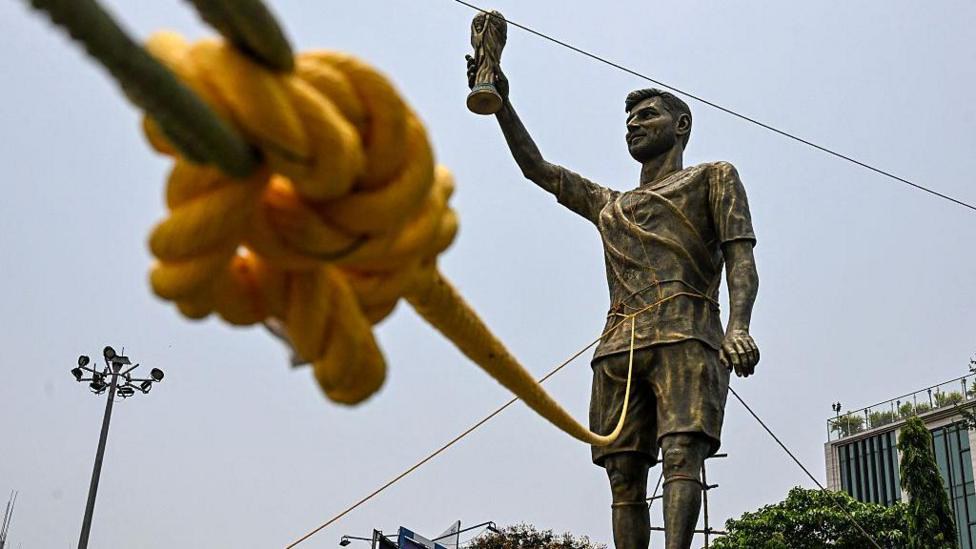
A massive 70ft tribute to Lionel Messi in West Bengal is being dismantled after engineers found the structure swaying dangerously in the wind.
The line between a monument and a hazard is often drawn by the invisible hands of engineering, and in Kolkata, that line has been crossed. A towering 70-foot statue of Lionel Messi, erected to celebrate the Argentine legend's status as the greatest of all time, is facing an ignominious end. Local authorities in West Bengal have ordered the immediate dismantling and relocation of the massive structure after residents reported seeing the figure swaying precariously during recent gusts of wind. What was intended to be a permanent landmark of footballing devotion has instead become a source of anxiety for the thousands who pass by it daily.
A Structural Failure in the Face of the Elements
The inspection that sealed the statue's fate was carried out by engineers from the Public Works Department (PWD) on Monday. Their findings were stark: the structural integrity of the monument is severely compromised. Standing at such a height, the leverage exerted by the wind on the upper sections of the statue has begun to strain the internal skeleton beyond its design limits. State legislator Sharadwat Mukherjee confirmed the gravity of the situation, stating that the Argentine legend's likeness was officially deemed unsafe for public display in its current state.
The sight of a 70-foot icon oscillating in the breeze is a haunting image for a city that prides itself on its engineering heritage. The statue is a composite structure, built using a combination of iron framing and fibreglass cladding. While these materials are lightweight and allow for intricate detailing, they offer significant wind resistance without the dampening properties of more solid materials like concrete or stone. The PWD report highlighted that the "swaying" was not merely a visual illusion but a tangible mechanical failure that could lead to a catastrophic collapse if left unaddressed in the middle of a busy urban area.
The Rush to Commemorate a Living Legend
To understand how such a grand project reached this point, one must look back to its inception during Messi's 'GOAT' tour branding in December. The statue was a product of intense labor and perhaps even more intense deadlines. A crew of 45 people worked around the clock for 27 days to assemble the monument, a timeline that many in the local construction industry now view with skepticism. The pressure to have the statue ready for its virtual unveiling—which Messi himself performed via video link—may have led to compromises in the foundational stability required for a structure of this magnitude.
When Messi pressed the button on his remote control thousands of miles away to reveal the statue, the atmosphere in Kolkata was electric. However, that celebration was already marred by external factors, including reported violence at Salt Lake Stadium during the legend's virtual visit. The haste of the project combined with the immense scale created a perfect storm. At 70 feet, the statue dwarfs the surrounding architecture, making it a lightning rod for the heavy winds that frequently sweep through West Bengal. The ambition of the 45-strong crew was noble, but the physics of such a massive build required a level of scrutiny that the 27-day window clearly did not permit.
The Logistics of a Dangerous Dismantling
Removing a 70-foot statue is not a simple task, particularly when it is located in one of the most congested cities in the world. Mukherjee pointed out that the site's proximity to a busy main road and a subway station makes the operation incredibly delicate. Engineers cannot simply topple the structure; it must be deconstructed with the same care with which it was built, if not more. Currently, the statue has been lashed with heavy-duty nylon ropes to prevent further movement, a temporary measure that looks more like a tethered giant from a fairy tale than a modern sporting monument.
Authorities have already erected safety barricades to keep pedestrians and motorists at a distance, effectively creating a no-go zone around the Argentine icon. The plan is to remove the statue at the earliest possible opportunity, though the logistics of bringing in heavy machinery without disrupting the city's vital transport links are daunting. There is a palpable sense of urgency, as each passing day of wind increases the risk of a structural snap. The relocation is not just about moving a piece of art; it is about mitigating a public safety emergency that sits at the heart of the community.
Kolkata's Enduring Love for the Albiceleste
Despite the structural failure of the monument, the sentiment behind it remains unshaken. Kolkata has a long and storied history of supporting the Argentine national team, a devotion that borders on the religious. During the 2022 World Cup, the city was draped in blue and white, and the erection of this statue was seen as the ultimate expression of that bond. For many residents, the statue was a point of pride, a way to show the world that the heart of South American football beats as strongly in India as it does in Buenos Aires. The disappointment over its removal is tempered by the realization that a falling statue would be a tragedy no one wants associated with Messi's name.
Officials are already scouting alternative locations where a reinforced version of the statue might safely stand. The goal is to find a site with better wind protection or a more substantial foundation that can accommodate the iron and fibreglass weight. This search for a new home reflects the city's refusal to let the project die entirely. The 'GOAT' tour may have left behind a swaying monument, but the desire to honor the man who led Argentina to global glory remains the driving force for the local government. They are determined to ensure that if Messi is to stand over Kolkata, he does so on solid ground.
A Lesson in Sporting Monuments
The saga of the swaying Messi statue serves as a cautionary tale for the global football community. In the rush to immortalize modern heroes, the practicalities of construction and environmental factors are sometimes sidelined by the desire for a viral moment. We have seen many statues of footballers go wrong—from the infamous Cristiano Ronaldo bust in Madeira to the questionable likenesses of Mohamed Salah—but rarely do they pose a physical threat to the public. The 70-foot Messi is a reminder that the bigger the tribute, the bigger the responsibility.
As the nylon ropes hold the iron frame steady against the West Bengal gusts, the city waits for the next phase of this architectural drama. The removal will be a somber sight for the fans who gathered to watch its virtual unveiling just months ago. However, the safety of the citizens must always take precedence over the aesthetics of fandom. Messi's legacy is built on the firmest of foundations—his achievements on the pitch—and it does not require a swaying tower of fibreglass to sustain it. When the statue finally comes down, it will be with the hope that a more permanent, safer tribute can one day take its place. more football news on MATCHLINE