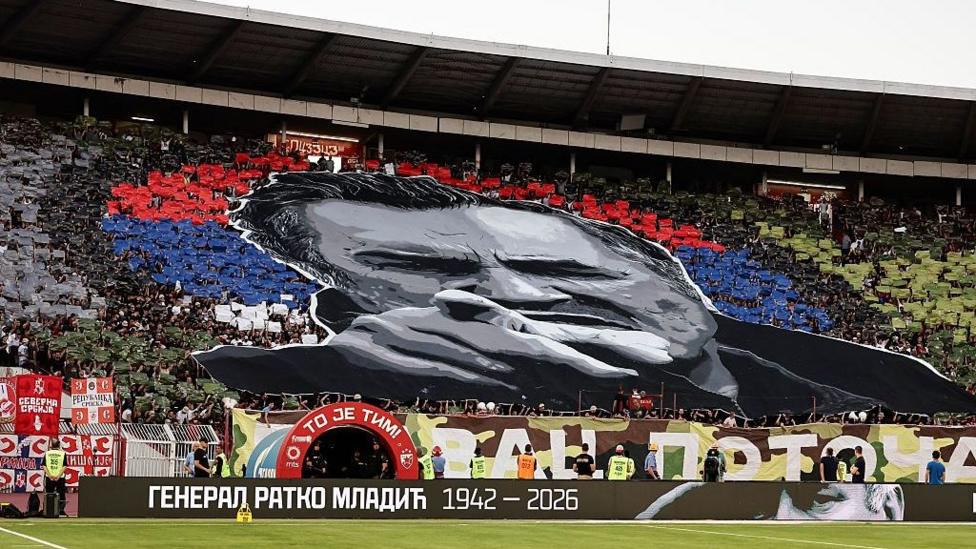
Red Star Belgrade face severe backlash after supporters displayed a massive tifo of convicted war criminal Ratko Mladic during the Eternal Derby.
The Eternal Derby between Red Star Belgrade and Partizan Belgrade is traditionally one of the most volatile fixtures in European football, but Sunday night's edition transcended sporting rivalry to enter the realm of international controversy. Before a ball was even kicked, the Red Star ultras, known as the Delije, unveiled an enormous tifo depicting Ratko Mladic, the former Bosnian Serb military commander convicted of genocide and crimes against humanity. The image of Mladic, who died in a United Nations prison this past August, transformed the stadium into a theater of political provocation.
Mladic remains a deeply polarizing figure in the Balkans. To his victims and the international community, he is the Butcher of Bosnia, the man responsible for the systematic slaughter of 8,000 Muslim men and boys at Srebrenica. To a vocal segment of Serbian nationalists, however, he is celebrated as a defender of the faith. By choosing to honor him during a match of such high visibility, Red Star's supporters have once again forced football into a confrontation with the region's bloodiest historical chapters, drawing immediate condemnation from neighboring nations and governing bodies alike.
A Victory Tainted by Nationalistic Display
On the pitch, Red Star secured a hard-fought 2-1 victory over their cross-city rivals, a result that would usually be the sole focus of the morning's headlines. The atmosphere was typical of the Belgrade derby: flares, deafening noise, and a palpable tension that often boils over into violence. However, the football felt like a secondary concern given the pre-match display. The tifo was not a spontaneous act but a choreographed statement of defiance, meticulously prepared and executed by the club's most ardent supporters.
The controversy was deepened by the club's official stance. Red Star's social media channels did not distance themselves from the display; instead, they published video footage of the tifo alongside a minute's silence observed by both sets of players for Mladic. The inclusion of a saluting emoji in the official post was viewed by many as an endorsement of the fans' tribute. This lack of institutional separation between the club and the glorification of a convicted war criminal has raised serious questions about the culture embedded within one of Serbia's most historic sporting institutions.
The reaction was swift. The official Twitter account of Bosnia-Herzegovina’s national team replied to the video with a blunt obscenity, reflecting the raw pain and anger that such displays continue to cause. For the families of those who died during the siege of Sarajevo or the massacre at Srebrenica, seeing Mladic honored in a football stadium is not a matter of free speech but a direct assault on the memory of the victims. It serves as a stark reminder that the wounds of the 1990s wars are far from healed.
The Bloody History of the Butcher of Bosnia
To understand the weight of the outrage, one must look at the specific crimes for which Mladic was convicted. As the head of the Bosnian Serb army, he oversaw a campaign of ethnic cleansing designed to remove the non-Serb population from Bosnia-Herzegovina. The Srebrenica massacre, which occurred in 1995, was the single worst act of mass killing on European soil since World War II. Mladic was captured on film at the time, handing out sweets to children just hours before his troops began the executions of their fathers and brothers.
In 2017, the International Criminal Tribunal for the former Yugoslavia (ICTY) sentenced Mladic to life imprisonment. The court found him guilty of genocide, war crimes, and crimes against humanity. The judgment detailed a horrific list of atrocities, including the use of snipers and shelling against civilians in Sarajevo, where more than 10,000 people were killed during a 1,425-day siege. These are not disputed historical claims but findings established through years of forensic evidence and survivor testimony.
Despite this, a culture of denial persists in certain parts of Serbian society. For years, Mladic enjoyed the protection of the state, living in hiding until his eventual arrest in 2011. Even after his conviction, he has been portrayed by some as a martyr for the Serbian cause. The tifo at the Marakana is the latest manifestation of this narrative, using the platform of a football stadium to signal that his actions are still viewed with pride by a significant portion of the fanbase.
A Repeat Offense in European Competition
This is not an isolated incident for Red Star Belgrade. The club has a long and documented history of disciplinary issues related to the behavior of its supporters. Only last month, UEFA fined the club 90,000 euros following a Europa League play-off match against the Czech side FC Viktoria Plzen. During that game, fans unveiled a banner also commemorating Mladic, leading to a swift financial penalty from European football's governing body. The repeat nature of the offense suggests that current fines are doing little to deter the Delije.
UEFA has a strict policy regarding the use of political symbols and the promotion of figures associated with war crimes. Article 16 of the UEFA Disciplinary Regulations prohibits the use of gestures, words, objects, or any other means to transmit any message that is not fit for a sports event, particularly messages that are of a political, ideological, religious, or offensive nature. Given that Red Star had already been warned and fined this season, the tifo in the domestic derby could lead to even more severe sanctions if it is deemed to have brought the game into disrepute on an international level.
The challenge for governing bodies is how to handle incidents that occur within domestic leagues but have such profound international implications. While the Eternal Derby is a Serbian league match, Red Star is a regular participant in European competitions. The club's failure to regulate the actions of its fans and its own social media presence puts it at risk of stadium closures or even exclusion from UEFA tournaments if the pattern of behavior continues. The repetitive nature of these displays points to a systemic issue that goes beyond a few rogue individuals.
The Polarized Legacy of a Convicted War Criminal
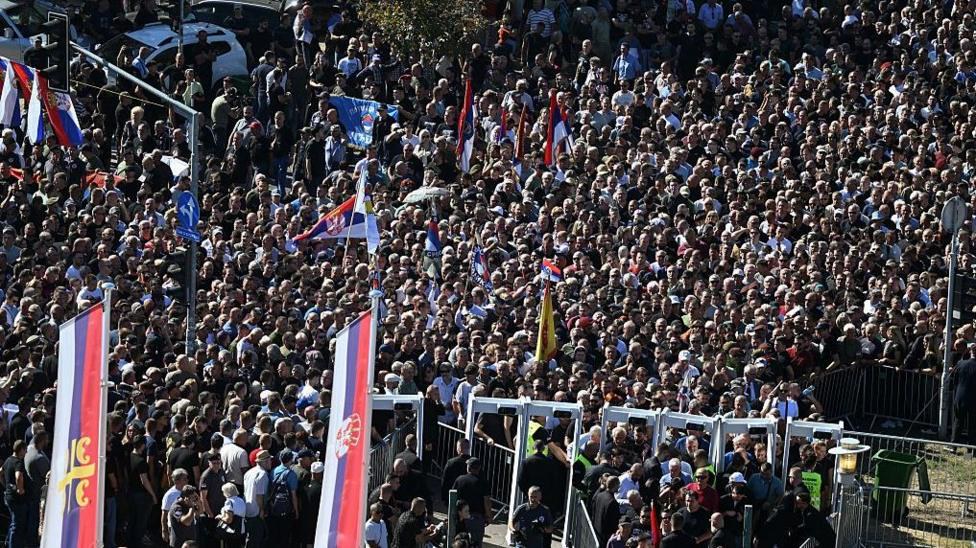
The tifo was just one part of a larger week of commemoration for Mladic in Belgrade. Following his death in the UN prison in The Hague, thousands of people gathered at a public memorial and church service on Monday. The funeral proceedings were marked by a heavy police presence and a somber atmosphere, as supporters paid their respects to the man they still consider a hero. This widespread display of support illustrates the deep disconnect between the international legal consensus and the local sentiment in certain Serbian circles.
Mladic's death has, if anything, intensified his status as a symbol of Serbian resistance against Western intervention. The fact that he died while in custody is seen by some as evidence of an unfair trial, despite the exhaustive evidence presented by the prosecution. This sentiment is often channeled through football, where the stadium becomes a space to voice political views that might be more carefully managed in other public spheres. The Delije have long been more than just a football firm; they are a political force with significant influence within the club and the city.
UEFA’s Looming Hammer and the Culture of Impunity
The international football community is now looking toward UEFA and the Serbian FA to see what, if any, action will be taken. Fines alone have proven ineffective at curbing the glorification of war criminals. There is a growing chorus of voices calling for more drastic measures, such as points deductions or lengthy stadium bans, to force the club's hierarchy to take real responsibility for the environment they allow to persist within the stadium. The fact that the club's official accounts celebrated the moment suggests that the leadership is either unwilling or unable to confront the ultra-nationalist element of their support.
Red Star Belgrade is a club with a proud European history, famously winning the European Cup in 1991. However, that legacy is increasingly being overshadowed by the political actions of its supporters. As football strives to become more inclusive and move away from its darker associations with extremism, the situation in Belgrade represents a significant obstacle. Without firm intervention, the Marakana will continue to be used as a billboard for messages that have no place in a modern sporting environment.
The fallout from Sunday night is likely to continue for weeks as the various football authorities review the footage and the social media conduct. For the victims of the wars in the former Yugoslavia, the sight of a war criminal being hailed as a hero in a packed stadium is a painful reminder of the work still needed to achieve true reconciliation in the region. The game of football, intended to unite, has once again been used to reinforce the divisions of the past.
Stay updated on the latest disciplinary news and European football developments at more football news on MATCHLINE.