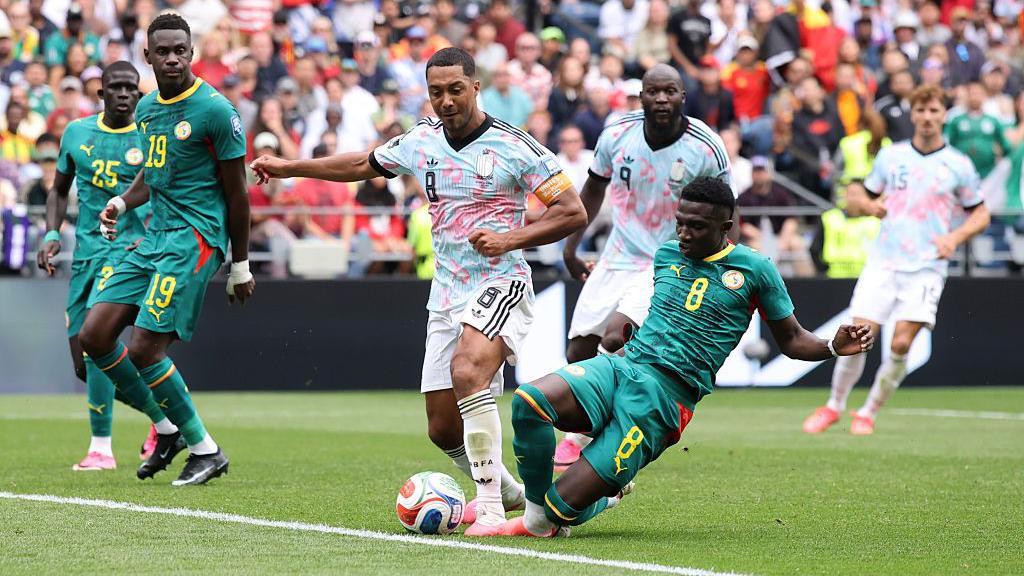
A 125th-minute penalty from Youri Tielemans capped a remarkable 3-2 victory for Belgium, ending Senegal's World Cup dreams in the Round of 32.
The script was written, the celebrations were prepared, and Senegal were moments away from the most significant victory in their recent history. For 86 minutes in Seattle, Pape Thiaw’s side had not just competed with Belgium; they had systematically dismantled them. Leading 2-0 through goals from Habib Diarra and Ismaila Sarr, the Lions of Teranga looked certain of a place in the last 16. What followed was a collapse of such breathtaking proportions that it will be analyzed for generations, a sequence of events that saw Belgium rise from the dead to secure a 3-2 win in the final seconds of extra time.
A Recovery Beyond Recognition
No team in the history of the World Cup has ever navigated a more perilous position than the one Belgium faced as the clock ticked toward the 90-minute mark. Trailing by two goals with only four minutes of regulation time remaining, the Red Devils looked like a spent force, a golden generation finally losing its luster. Rudi Garcia’s side was disjointed, frustrated, and seemingly out of ideas. Yet, football has a habit of rewarding those who refuse to yield, and Belgium’s veteran core proved they still possess the resilience that carried them to the podium in 2018.
The catalyst for the recovery was Romelu Lukaku. The 33-year-old striker, whose inclusion in the squad was questioned following a season where he managed only 69 minutes of club football, proved his critics wrong with a single instinctive finish. In the 86th minute, he ghosted onto a Thomas Meunier cross to flick the ball past Mory Diaw. It was a goal born of pure experience, a moment that shifted the atmospheric pressure within the stadium and sowed the first seeds of doubt in a Senegalese defense that had been impenetrable for the preceding hour and a half.
The equalizer arrived just three minutes later, a moment of chaos that saw Senegal’s composure vanish. Leandro Trossard, who had spent the second half in a visible on-pitch argument with his captain, delivered a searching cross into the box. Diaw, so impressive throughout the tournament, misjudged the flight of the ball entirely. Youri Tielemans was the beneficiary, rising highest to nod into an empty net. It was the latest any team has ever trailed by two goals in a World Cup match and still managed to avoid defeat within 90 minutes.
Controversy and the 125th-Minute Penalty
If the comeback was dramatic, the conclusion was explosive. As the game entered the final moments of extra time, with both sets of players visibly exhausted and the specter of a penalty shootout looming, the video assistant referee (VAR) intervened. Lamine Camara was judged to have fouled Tielemans in the box, a decision that triggered immediate and fierce protests from the Senegalese bench and sparked a lengthy review at the pitchside monitor.
Refereeing experts and former players were quick to debate the validity of the award. The challenge appeared minimal in real-time, but under the forensic scrutiny of slow-motion replays, the contact was deemed sufficient. Tielemans, carrying the weight of a nation’s expectations, stepped up to the spot 125 minutes into the contest. He converted with clinical precision, marking the latest winning goal in World Cup history and condemning Senegal to a defeat that felt like a repeat of their recent Africa Cup of Nations heartbreak.
For Senegal, this was more than just a loss; it was a psychological blow that will be difficult to recover from. Having been stripped of their Afcon title earlier this year under controversial circumstances, the nature of this exit felt cruel. Manager Pape Thiaw was left to lament his side’s inability to close out a game they had dominated. The Lions of Teranga were the better side for 70 minutes, but in the crucible of knockout football, dominance without a finish is a dangerous currency.
The Final Charge of the Golden Generation
While much of the talk will center on the officiating and the Senegalese collapse, Belgium’s ability to survive remains the headline. Only five players remain from the squad that finished third in Russia eight years ago: Courtois, De Bruyne, Meunier, Lukaku, and Witsel. This victory was a testament to that collective memory. They have been here before, specifically in 2018 when they overcame a two-goal deficit against Japan. That experience proved vital when the younger members of the squad began to fray under the pressure.
Kevin de Bruyne’s substitution in the 56th minute was a moment of high tension, with the playmaker visibly frustrated as he left the field. It was his earliest departure from a World Cup match, and it felt like a symbolic passing of the torch. However, it was the bickering duo of Trossard and Tielemans who eventually stepped up to fill the creative void. Their argument during a second-half hydration break was a sign of a team at its breaking point, yet they managed to channel that friction into a match-winning partnership.
Belgium now moves on to a last-16 encounter with either the United States or Bosnia-Herzegovina. They are far from the finished article, and their defensive vulnerabilities were exposed repeatedly by the pace of the Senegalese attack. But a win of this magnitude creates a momentum that is hard to quantify. They are a team that knows how to win when they are playing poorly, a trait that is often the hallmark of tournament winners. The old guard has at least one more battle left in them.
Seattle’s Night of Pure Theatre
The atmosphere in Seattle was one of disbelief as the final whistle blew. Senegal’s fans, who had provided a rhythmic, constant backdrop to the match, were silenced by the sheer improbability of the result. Ismaila Sarr’s goal, a piece of technical brilliance that will surely be a contender for goal of the tournament, was relegated to a footnote. Sarr had shown incredible footwork to double the lead, evoking memories of the legendary Dennis Bergkamp, but even that piece of magic could not save his side.
Senegal will point to the absence of Edouard Mendy as a turning point, with Mory Diaw’s error for the second goal proving catastrophic. In the high-stakes environment of the World Cup, small margins determine legacies. Senegal played with flair, bravery, and tactical intelligence for the majority of the game, but they failed to manage the closing stages. They allowed Belgium back into the contest through a combination of tactical passivity and individual errors.
As Belgium celebrates, the rest of the tournament has been served a warning. You cannot count out a team with this much elite experience, no matter how dire the situation appears. The Red Devils have pulled off a great escape that matches the efforts of Germany in 1954 and 1970. It was a night where logic was suspended and the raw, unpredictable nature of knockout football took center stage. The road to the final remains long, but Belgium has proven they have the stomach for the fight.