Republic of Ireland manager Heimir Hallgrimsson believes the controversy surrounding recent Nations League fixtures has forged a new, resilient squad identity.
In the high-pressure cooker of international football, managers often search for a catalyst to bond a disparate group of players into a cohesive unit. For Heimir Hallgrimsson and the Republic of Ireland, that catalyst arrived not in a tactical masterclass, but in a storm of geopolitical and internal tension. The Irish manager has identified the recent Nations League saga involving fixtures against Israel as a "defining moment" for his tenure, claiming that the external protests and internal debates have hardened his squad in ways that routine training sessions never could.
The lead-up to the September and October international windows was fraught with difficulty. Amid widespread protests regarding the ongoing conflict in Gaza, the Irish players were forced to confront the ethics of their participation. A squad vote was held to determine whether they should proceed with the matches, a rare and heavy burden for professional athletes to carry. With goalkeeper Gavin Bazunu making the personal choice to remain unavailable for selection, the team was operating in a state of high emotional sensitivity, yet they emerged with a win and a draw that have fundamentally altered their trajectory.
The Siege Mentality
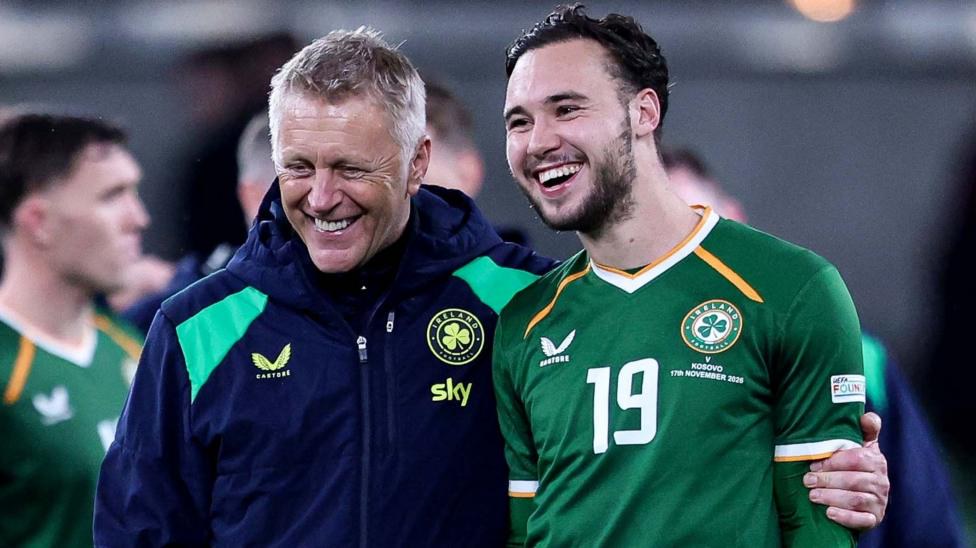
Hallgrimsson, the Icelander who famously steered his own nation to the quarter-finals of Euro 2016, knows the value of a "us against the world" mentality. Speaking after his side’s emphatic 3-0 victory over Kosovo in Dublin, he reflected on the lessons learned during those turbulent weeks. "Us as leaders sometimes artificially create that environment to get the group to stick together," Hallgrimsson noted. "I have said we got that environment for free for two or three weeks and we survived it. It made this team and this group stronger."
The results on the pitch backed up his theory. Ireland secured a dominant 3-0 win in Hungary before battling to a 1-1 draw in Serbia, results that laid the groundwork for their runner-up finish in Group B3. By the time they arrived back in Dublin to face a 1-10-man Kosovo side, the confidence was visible. Troy Parrott’s composure from the penalty spot and Jack Moylan’s clinical finish were the end products of a team that finally looks comfortable in its own skin. The manager believes that in years to come, this period will be viewed as the foundation of future Irish success.
Pot Two and the Path to 2028
The sporting consequences of this newfound resilience are significant. Finishing second to Austria ensures that the Republic of Ireland will be placed in Pot Two for the Euro 2028 qualifying draw. This is a crucial strategic advantage, theoretically providing a smoother path to the finals of a tournament they will co-host. Additionally, it secures a promotion/relegation play-off in March against a League A opponent, offering a genuine chance to climb into the top tier of European international football for the first time.
Hallgrimsson is relishing the prospect of facing elite opposition. The potential draw includes the likes of Croatia, Serbia, Denmark, or Wales—teams that will provide a stern litmus test for Ireland’s progress. "Those teams will expose your weaknesses and that helps you in your growth," Hallgrimsson explained. The manager is clearly moving away from the era of experimental friendlies, preferring the sharp edge of competitive stakes to sharpen his players' resolve. The goal is to build a team that is, in his own words, "difficult to play against."
Tactical Consistency and Squad Evolution
Beyond the psychology of the group, Hallgrimsson has spent his first few months in charge implementing a much-needed sense of structural stability. For too long, the Irish squad appeared to be in a state of constant flux, with frequent changes in system and personnel. The manager now believes he has found his core. By consistently selecting the same group of players and sticking to a defined tactical system, the natural connections between players are finally starting to emerge on the pitch.
The win against Kosovo was a prime example of this emerging identity. Even though the visitors were hampered by the early dismissal of Kreshnik Hajrizi, Ireland’s ability to maintain pressure and exploit the man advantage showed a maturity that has been missing in recent years. The integration of young talents like Harvey Vale alongside seasoned campaigners suggests a balanced squad that is beginning to understand exactly what their manager demands of them. Hallgrimsson is no longer looking for answers; he is looking for refinement.
The Legacy of the Israel Controversy
While the footballing world often tries to separate sport from politics, the Ireland-Israel fixtures proved that such a divide is often impossible. The decision of the players to vote on their participation was a landmark moment in player empowerment, reflecting a generation of footballers who are increasingly unwilling to be silent pawns. By navigating this without fracturing the dressing room, Hallgrimsson has passed his first major leadership test. He didn't just manage a football team; he managed a crisis.
The absence of Gavin Bazunu remains a talking point, but it appears to have been handled with a level of professional respect that allowed the group to move forward. Rather than becoming a point of division, the individual and collective choices made by the squad seem to have fostered a culture of mutual trust. If Hallgrimsson can maintain this atmosphere, Ireland may finally have the psychological foundation needed to compete with the heavyweights of European football once again.
Looking Ahead to March
The upcoming draw on Friday will determine the next chapter of this journey. The Republic is now a team transformed from the hesitant outfit seen earlier in the year. They are aggressive, structurally sound, and underpinned by a shared experience of hardship. March will bring two tough games, but for Hallgrimsson, that is exactly the point. He is building a team for the long haul, using every controversy and every difficult result as fuel for the fire.
Ireland fans have seen false dawns before, but there is a different feel to the Hallgrimsson era. It is pragmatic, hard-nosed, and deeply connected to the identity of the players. As they prepare for the Euro 2028 cycle, they do so not just as a collection of talented individuals, but as a unit that has already survived its first baptism of fire. The road to the top tier is long, but for the first time in a while, the Republic of Ireland knows exactly which direction they are heading. more football news on MATCHLINE