As the Czech Republic prepare for a Nations League clash at Wembley, the ghosts of Euro 96 and Oliver Bierhoff’s golden goal still haunt North London.
Wembley’s arch may have replaced the iconic twin towers, but for Czech football, the air in North London still carries the ghostly scent of June 1996. The Czech Republic return to the spiritual home of English football this international break for a Nations League double-header that serves as more than just a quest for points. It is a thirty-year anniversary pilgrimage to the site of their greatest modern triumph and most agonizing heartbreak. Facing England twice in Group A3—first in Prague and then at the rebuilt Wembley on October 6—the Czechs find themselves looking back at a summer that defined a nation just three years after its peaceful divorce from Slovakia.
The journey back to Wembley is steeped in a nostalgia that few teams can match. In 1996, the Czech Republic arrived in England as the ultimate outsiders, a squad composed largely of domestic-based players who were so convinced of an early exit that many had pre-booked family holidays for the day after the group stages concluded. Vladimir Smicer had famously scheduled his wedding for the week of the final, never imagining he would be busy playing in it. This was a team of unknowns who would, over the course of three weeks, become household names across the continent, fundamentally altering the landscape of European football recruitment for the decade that followed.
The Accidental Finalists of 96
Nobody gave the Czechs a chance when they were drawn in a group of death alongside Germany, Italy, and Russia. Even their opponents were dismissive; Patrik Berger recalled his then-Borussia Dortmund teammate Jurgen Kohler asking if he was visiting England just to watch the games. The laughter from the German defender stopped quickly enough. After a sobering 2-0 defeat to Germany in their opener, the Czechs ignited their tournament with a stunning 2-1 victory over Italy at Anfield. It was a result that sent shockwaves through the competition, proving that Dusan Uhrin’s side possessed a tactical discipline and counter-attacking lethality that could dismantle the world’s best.
The drama of their progression was Hollywood-esque. Needing a result against Russia, they found themselves trailing late on until Vladimir Smicer, a future Liverpool hero, leathered home a late equalizer at Anfield. That 3-3 draw, combined with Italy’s failure to beat Germany, sent the Czechs through by the skin of their teeth. Berger admits the players were in a state of confusion on the pitch, unaware of the other result until the final whistle. The realization that they had reached the quarter-finals changed the mood from relief to belief, transforming a group of holiday-planners into a focused unit of giant-killers.
The knockout stages cemented their status as the tournament’s main attraction. Karel Poborsky’s audacious scoop over Vitor Baia at Villa Park remains one of the most aesthetically perfect goals in the history of the European Championship. It was the moment the world met the man with the flowing hair and the delicate touch, a player who would soon become a staple of Manchester United’s midfield. By the time they reached the semi-finals to face France, the Czech Republic had become the neutral’s favorite, playing with a freedom that masked the immense pressure of the occasion. A tense penalty shootout win over the French at Old Trafford set up a romantic, if unlikely, return to Wembley.
Berger and the Wembley Penalty
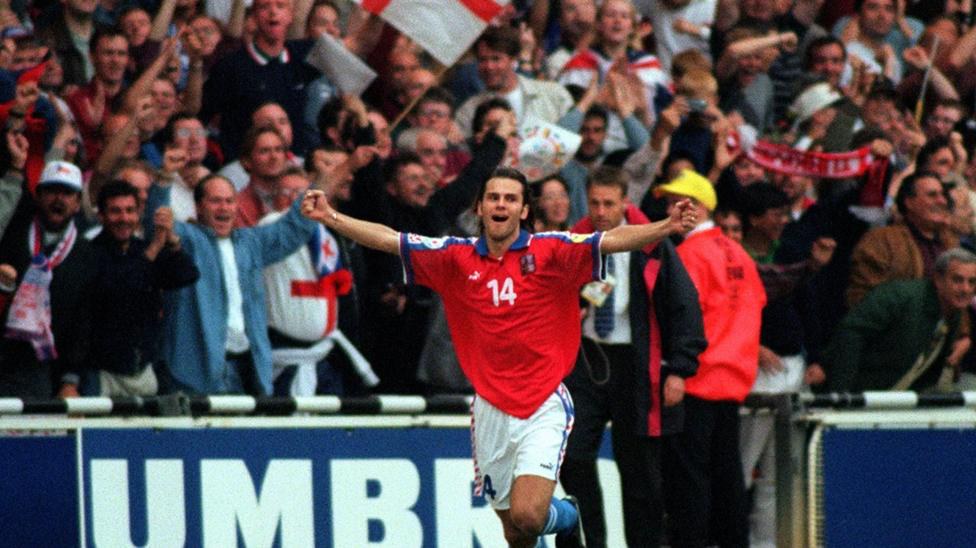
The final against Germany at the old Wembley was the peak of this miracle run. For 73 minutes, it looked as though the Czech Republic would complete the most improbable story in football history. When the referee pointed to the spot in the 59th minute, Patrik Berger stepped up, despite not being the designated taker. He sensed the hesitation in his teammates and took the responsibility himself, drilling the ball low and hard past Andreas Kopke. The image of Berger celebrating in front of the Czech fans is etched into the nation's sporting consciousness, a moment where silver felt like it was turning into pure gold.
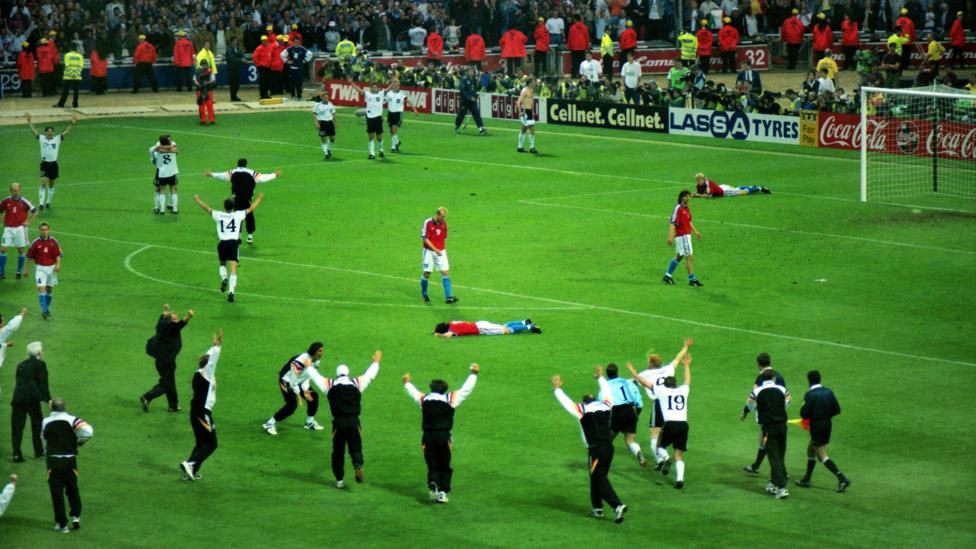
However, the narrative took a cruel turn that would introduce a new rule to the footballing lexicon: the Golden Goal. Oliver Bierhoff, brought on as a substitute, equalized for Germany before striking again in extra time. His shot took a wicked deflection, squirming through the grasp of Petr Kouba and ending the game instantly. It was a brutal way to lose, a sudden-death conclusion that left the Czech players slumped on the turf while the Germans celebrated. Berger reflects on it now without bitterness, noting that while he would love to be a European champion, that silver medal opened the doors of the Premier League to an entire generation of Czech talent.
The Golden Generation and the Decline
The success of 1996 was not a flash in the pan but the start of a golden era. While the 1996 squad relied on grit and surprise, the 2004 team that reached the semi-finals in Portugal is widely considered the superior technical side. Featuring a peak Pavel Nedved, a young Petr Cech, and the clinical Milan Baros, that team played a brand of swashbuckling football that many felt deserved the trophy. Their exit to Greece in the semi-finals remains a sore point for fans who believe that 2004, rather than 1996, was their true missed opportunity. It was the last time the Czechs felt like genuine heavyweights on the world stage.
Since those heady days, the production line of world-class talent has slowed significantly. While the Czech Republic reached the quarter-finals in 2012 and 2021, they have lacked the transformative superstars like Nedved or Rosicky who could dominate a midfield at the highest level. Journalists in Prague point to a lack of representation in Europe’s elite clubs as the primary reason for this stagnation. Whereas the 96 and 04 squads were littered with players at Liverpool, Manchester United, Milan, and Juventus, the current crop struggles to find consistent minutes in the top four leagues. The gap between the miraculous past and the functional present has never felt wider.
Santi Denia and a New Philosophy
The current Nations League campaign marks a radical departure for the national team with the appointment of Santi Denia. As the first foreign manager in the history of the Czech Republic, the Spaniard is tasked with modernizing a system that has become overly reliant on physicality and set pieces. Denia’s first squad for the matches against Croatia, England, and Spain reflects a desire for fresh blood, including seven players with little to no international experience. He is attempting to instill a more possession-based approach, a difficult task for a nation that has traditionally excelled in the transition.
Wembley provides the ultimate litmus test for this new philosophy. The stadium is no longer the crumbling relic of 1996 but a gleaming cathedral of the modern game. For the young players in Denia's squad, this is a chance to step out from the long shadows cast by Berger and Poborsky. While the veterans of 96 are skeptical that this generation can reach the same heights, the Nations League offers a platform to prove that Czech football is not merely a museum of past glories. They head to London not just to commemorate a thirty-year anniversary, but to begin writing a narrative that isn't defined by a silver medal and a golden goal.
The stakes are high for both nations, but for the visitors, the weight of history is a constant companion. As the teams walk out onto the Wembley turf, the memories of 1996 will be inescapable. Whether Denia’s side can channel that spirit of defiance or whether they will be overwhelmed by the occasion remains to be seen. One thing is certain: in the hearts of the travelling fans, the dream of another miracle in North London never truly dies. Catch all the latest international coverage and more football news on MATCHLINE.