At 40 years old, Edin Dzeko prepares for a final World Cup campaign with Bosnia, carrying the scars of war and the hopes of a defiant nation.
Edin Dzeko arrived at the 2026 World Cup nursing his arm in a sling, a physical manifestation of the literal and metaphorical weight he has carried for two decades. At 40, the man known as the Bosnian Diamond is preparing for a final international chapter that many in his homeland feared would never come. Moments after leading Bosnia-Herzegovina through a grueling penalty shootout against Italy to secure qualification, Dzeko stood not as an untouchable superstar, but as a vulnerable leader of a resilient nation. His career has long been a mirror for the country itself: defined by persistence, tempered by conflict, and constantly proving the doubters wrong on the global stage.
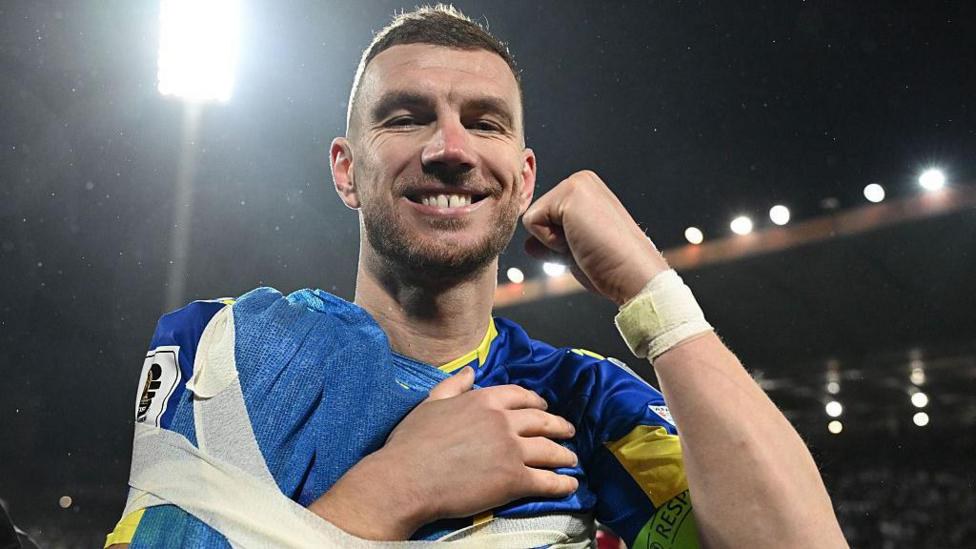
The image of Dzeko leading his team into their opening fixture against Canada is one of profound symbolic power. He is the last bridge to a golden generation that first tasted World Cup football in 2014, and his presence provides a steady hand for a squad that is increasingly young and diverse. For a country still grappling with the long shadow of its past, the national team remains one of the few institutions that commands universal trust. Dzeko is the anchor of that trust, a figure who has remained a constant while coaches, federations, and political climates have shifted around him like sand. This tournament is more than just a swan song for a legendary striker; it is the culmination of a life lived in defiance of the odds.
Forged in the Siege of Sarajevo
To understand Dzeko’s impact, one must understand the environment that shaped him. He was only six years old when the Bosnian War erupted in 1992, turning his childhood into a daily struggle for survival. His family was forced into a tiny apartment, sharing just 35 square meters with fifteen relatives as Serbian snipers targeted anything that moved in Sarajevo. Dzeko has often recounted how his mother’s intuition saved his life; one afternoon, she forbade him from playing on a local pitch just minutes before a shell landed on the field, killing several children who had been his playmates. Those memories are not distant history for Dzeko; they are the foundation of his legendary mental toughness.
Even after the guns fell silent, the road to professional football was paved with skepticism. In his early days at Zeljeznicar, Dzeko was cruelly nicknamed "Kloc" — a local slang term for a lamp-post — because of his lanky, awkward appearance. When Czech club Teplice offered a mere 25,000 euros for his services, the Zeljeznicar directors were reportedly laughing as they signed the paperwork, believing they had swindled the buyers. They were wrong. Dzeko would go on to become the first player in history to score at least 50 goals in the Premier League, Bundesliga, and Serie A, proving that the awkward boy from Sarajevo possessed a world-class engine.
The Weight of a Decade of Heartbreak
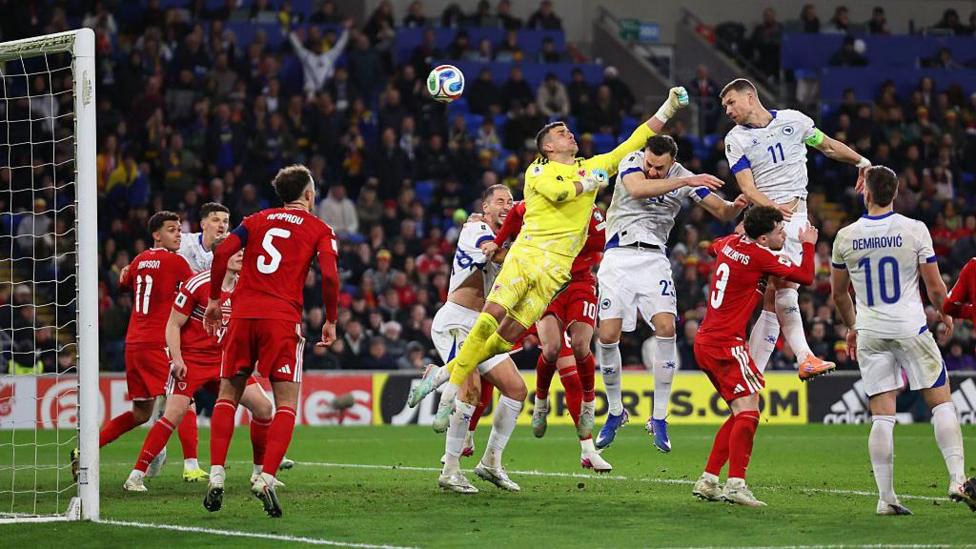
The journey back to the World Cup has been agonizing for Bosnia. Since their debut in Brazil twelve years ago, the national team has been haunted by playoff failures, losing out on major tournaments in 2016, 2020, and 2024. Each near-miss deepened a sense of national pessimism, a feeling that the country’s moment on the sporting stage had passed with the aging of its stars. The veteran's fitness is matched only by his timing. During the grueling playoff process, it was Dzeko who rose highest to scramble home a desperate late equalizer against Wales, a goal that shifted the momentum of Bosnia's entire campaign.
When the final whistle blew in the playoff final against Italy, the release of tension was seismic. In Sarajevo, thousands of supporters flooded the streets, partying until dawn in a celebration that carried unusual weight in a country often divided by political and economic uncertainty. This qualification feels heavier emotionally than the first in 2014 because it represents a successful fight against decline. It has given a new generation of supporters a team they can call their own, anchored by the same man their parents cheered for a decade ago. For Bosnia, football is the ultimate vessel for "Bosanski Inat" — a unique cultural mindset of stubborn defiance.
A Squad Born of the Diaspora
The modern Bosnian squad is a fascinating mosaic of the country's turbulent history. Seventeen of the 26 players in Sergej Barbarez’s World Cup squad were born outside of Bosnia-Herzegovina, the children of families who fled the conflict in the 1990s. This diaspora, estimated at over two million people, has provided a lifeline for the national team. Players who grew up in the elite academies of Germany, Sweden, and the United States have chosen to return to their roots, drawn by a powerful sense of national identity. This unique dynamic has created a team that mixes elite European tactical training with the raw passion of their heritage.
Esmir Bajraktarevic, the 21-year-old who scored the decisive penalty to send Bosnia to this tournament, is the face of this new wave. Born and raised in Wisconsin after his parents fled Srebrenica, his journey back to represent Bosnia is a common narrative within the camp. This shared history of struggle creates a bond that transcends their disparate upbringings. When they step onto the pitch, they are not just representing a federation; they are representing a scattered people who have found a common home in the blue and yellow shirt. Dzeko acts as the patriarch for this group, bridging the gap between those who lived through the war and those who inherited its legacy.
Leadership Beyond the Goalmouth
Dzeko’s role in the squad has evolved into something far more significant than that of a traditional captain. He is a moral compass for a nation that often lacks one. Ahead of the crucial playoff against Italy, when videos emerged of Italian players allegedly celebrating the fact they had drawn Bosnia, Dzeko did not reach for anger. Instead, he reminded his supporters and teammates that Italy was the first nation to visit Bosnia for a friendly after the war, urging them to show respect during the national anthem. It was a gesture of statesmanlike leadership that silenced the stadium and focused his team on the task at hand.
On the pitch, his influence remains undeniable despite his advancing years. He is no longer the explosive runner he was at Manchester City or Wolfsburg, but his intelligence in the box and ability to link play are sharper than ever. He spends hours before and after training working on his physical recovery, listening to a body that has played nearly 150 times for his country. His teammates feed off his calmness; they see a man who has won Premier League titles and Champions League matches still showing the same hunger in a Bosnian shirt that he did as a teenager in the ruins of Sarajevo. He leads by example, proving that age is secondary to appetite.
The Final Whistle in North America
As the match against Canada approaches, Dzeko knows that the eyes of a nation are fixed upon him. This World Cup is not just a personal milestone; it is an opportunity to change the lives of the young players around him, just as the 2014 tournament changed his. He has seen the lack of investment in Bosnian sporting infrastructure and knows that success on this stage is the only way to force change and inspire the next generation of children playing in the streets of Sarajevo. For Dzeko, every minute on the pitch is an act of gratitude to the sport that provided him a way out of the darkness.
The Bosnian Diamond may be entering his final dance, but the light he casts will be felt long after he hangs up his boots. Regardless of the results in Group B, Dzeko’s legacy is already secured as the greatest sporting ambassador his country has ever known. He survived a shell on a football pitch to become one of the most respected strikers of his generation, and in doing so, he gave Bosnia a reason to believe in itself again. As the anthem plays in Toronto, Dzeko will be standing tall, a survivor, a champion, and forever the heart of his nation. more football news on MATCHLINE