
As England prepare to face Mexico in the World Cup last 16, we explore the towering legacy of the Estadio Azteca, where Pele and Maradona made history.
Among world football’s great theatres, the Estadio Azteca might be the most majestic stage of all. Sat squat in the south of Mexico City, a sprawling metropolis bubbling atop a high-altitude valley surrounded by mountains, the Azteca is where the colour, noise and energy of football truly come to life. It is a place where the game’s most glorious kings have been crowned, and where England now return to face a crucible of noise and history in the World Cup last 16.

The Architectural Marvel of Pedro Ramirez Vazquez
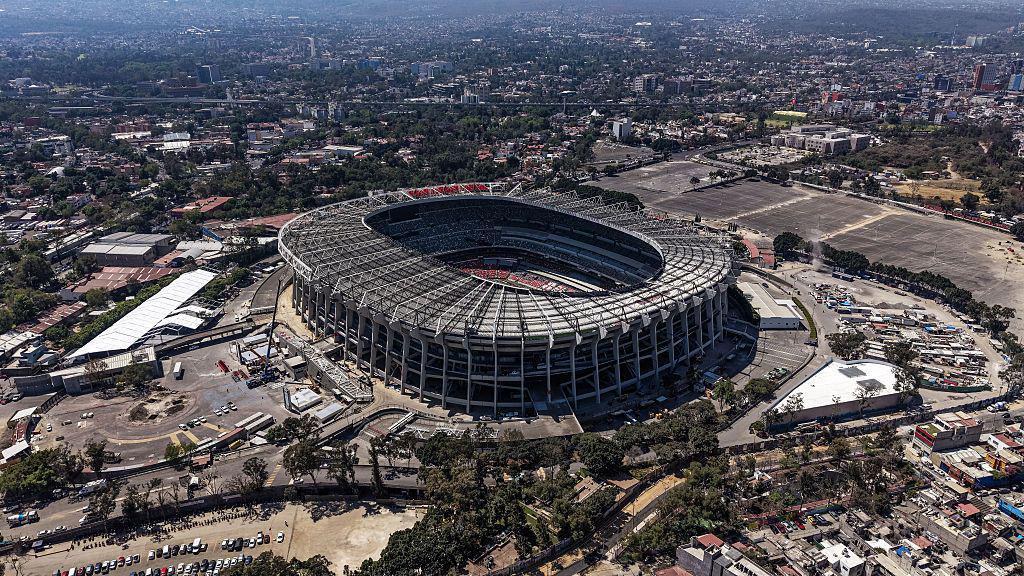
The sheer scale of the Azteca is the result of an immense feat of engineering. In the early 1960s, Mexico set its sights on hosting the 1970 World Cup, and architect Pedro Ramirez Vazquez was tasked with creating a venue that could rival Rio de Janeiro’s Maracana. To realize this vision, construction teams had to remove 180 million kilograms of rock from the volcanic landscape of the Santa Ursula district. What emerged was a stadium designed specifically to harness the power of the people.
Ramirez Vazquez prioritised the spectator experience above all else. Unlike the circular design of the Maracana, which he felt pushed fans too far from the action on the long sides of the pitch, the Azteca was built to envelop the grass. Its steep, towering sides and a pioneering cantilevered roof—constructed without columns to ensure unobstructed views—create an amphitheatre effect. This ensures that every one of the 87,500 fans feels as though they are practically on top of the players, making for an intimidating atmosphere for any visiting team.
The stadium’s design remains remarkably contemporary despite its age. Even after multiple refurbishments, the core principles of the architecture remain intact. The underground dressing rooms and the tight, dark tunnel leading to the pitch are designed to build tension. When players finally ascend the staircase into the light, they are greeted by a wall of sound that feels physical. This layout was intentional, designed to maximize the immersion of the game and turn the stadium into a living, breathing entity that reacts to every tackle and goal.
A Throne for Pele and Maradona
The Azteca is the only stadium to have hosted matches in three different editions of the World Cup, and its turf has been graced by the greatest to ever play the game. In 1970, it was the setting for what many consider the greatest team performance in history. Pele, seeking his third World Cup winner’s medal, led a Brazil side that dismantled Italy 4-1 in the final. The fourth goal, a sweeping move finished by Carlos Alberto, remains the gold standard for team goals, a sequence of passes that utilized the Azteca’s vast space and perfect surface.
Sixteen years later, the stadium belonged to Diego Maradona. It was here that the Argentine maestro produced the two most discussed goals in the history of the sport, both occurring within four minutes of each other against England. The infamous ‘Hand of God’ was followed by a solo run that saw Maradona dance past five England defenders and the goalkeeper in just 11 seconds. The Azteca roar that day was not just for a goal, but for a piece of sporting art that cemented Maradona’s legacy as a football deity.
The history of the stadium is not just limited to individual brilliance. It also hosted the 1970 semi-final between Italy and West Germany, a match so legendary it is simply known as the Game of the Century. After a 1-1 draw in regulation time, the two sides traded five goals in an extraordinary period of extra time, with the Italians eventually prevailing 4-3. A plaque at the stadium commemorates this match, a reminder that the Azteca is a place where the logic of football often gives way to pure, unadulterated drama.
The Sound of the Swarm
For those who have stepped onto the Azteca pitch, the experience is often described in visceral terms. The crowd generates a ferocious soundtrack that is unique in the world of sport. Former players describe a buzzing sound, akin to a swarm of bees, that vibrates through the tunnel even before they see the fans. This is the collective energy of tens of thousands of Mexicans, armed with horns and a relentless passion, creating a psychological barrier for any opponent. The aerial view of the massive bowl in the heart of Mexico City serves as a reminder of the sheer human mass players must contend with.
Communication on the pitch becomes virtually impossible once the match begins. The sound swirls around the steep stands, trapped by the cantilevered roof, creating a cacophony that drowns out tactical instructions. Mexican players are accustomed to this environment and use the energy to swarm their opponents from the opening whistle. They know that the crowd is their twelfth man, a force that can unsettle even the most experienced international veterans through sheer volume and intensity.
This home advantage is reflected in a staggering statistical record. Since Mexico began playing at the stadium in 1966, they have won 70 out of 89 competitive matches. Defeats here are so rare they are given names, such as the 'Aztecazo' of 2001 when Costa Rica managed a shock 2-0 victory. For the Mexican public, the stadium is more than just a sports venue; it is a fortress and a symbol of national pride. When the green shirts of the national team emerge from the tunnel, the atmosphere transcends sport and becomes a cultural event.
The Physiological Warfare of Altitude
Beyond the noise and the history, the Azteca presents a brutal physical challenge: altitude. Sitting 7,220 feet above sea level, the air is significantly thinner than at the coastal venues many European teams are used to. At this height, atmospheric pressure is lower, meaning players take in less oxygen with every breath. This leads to an increased heart rate and a quicker onset of fatigue, particularly for midfielders who are required to cover vast distances at high intensity.
The altitude affects the flight of the ball as well. In the thinner air, the ball travels faster and experiences less resistance, making long-range shots more unpredictable and crosses harder for goalkeepers to judge. For teams not acclimatised to these conditions, the middle of the first half can be a danger zone. As the initial adrenaline fades, the physiological reality of the altitude sets in, leading to lapses in concentration and defensive errors that the home side is always ready to exploit.
Medical experts note that while some adaptation is possible, the advantage remains firmly with those who live and train at height. The psychological impact is just as significant as the physiological one. Players who find themselves gasping for air early in the match can quickly lose their composure. Mexico often starts matches with a high-intensity press, designed to burn out their opponents before they can settle into a rhythm. It is a calculated form of sporting warfare that has undone many of the world's best teams over the decades.
England's Return to the Cauldron
For England, this match represents a chance to exorcise the ghosts of 1986. It has been decades since the Three Lions faced the unique challenges of the Azteca in a match of this magnitude. The current squad, led by Thomas Tuchel, must find a way to navigate both the historical weight of the venue and the immediate physical demands of the altitude. Tuchel has stressed the importance of remaining calm and composed, but the reality of the Azteca is that it tests a player's mental fortitude as much as their technical skill.
The tactical battle will be fascinating. England will likely look to control possession to manage their energy levels, while Mexico will attempt to turn the game into a high-tempo transition battle that plays into the strengths of the local environment. With a spot in the quarter-finals at stake, the pressure will be immense. The Azteca has a way of magnifying every mistake and glorifying every moment of brilliance, and on Sunday night, another chapter will be added to its storied history.
Whether it is a new king being crowned or a tactical masterclass from the visitors, the match promises to be a spectacle. The Azteca remains a cathedral of the game, a place where legends are made and where the soul of football is most visible. As the sun sets over the mountains surrounding Mexico City and the floodlights illuminate the hallowed turf, the world will be watching to see who conquers the most iconic stadium on the planet. more football news on MATCHLINE