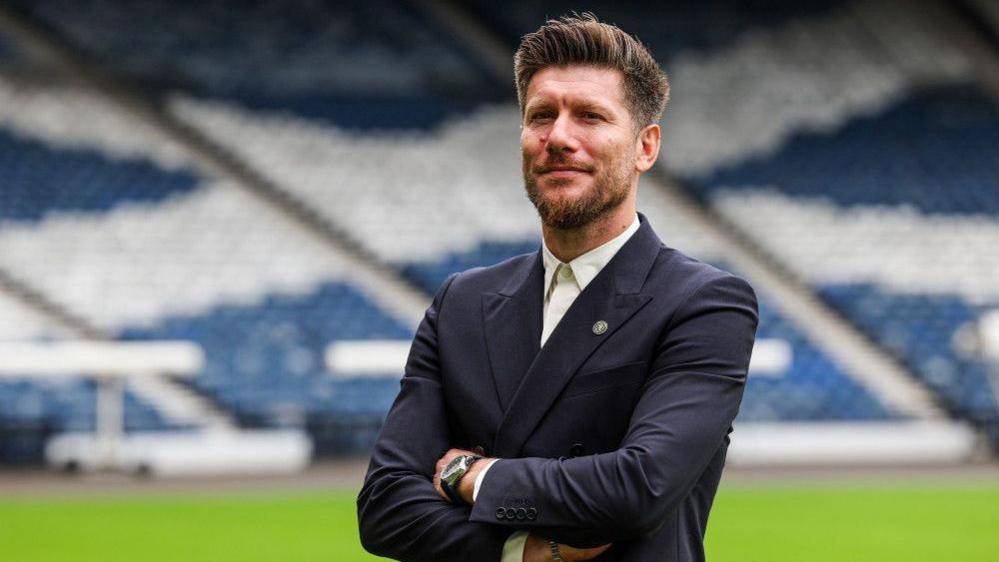
Sebastien Pocognoli has been unveiled as Steve Clarke's successor, promising a high-performance culture for the Scotland national team at Hampden Park.
The long shadows of the Steve Clarke era finally retreated at Hampden Park on Monday as Sebastien Pocognoli was formally introduced to the world as the new manager of the Scotland men’s national team. Replacing a figure as culturally embedded as Clarke, who held the reins for seven years, is no small feat, yet the 39-year-old Belgian arrived with the self-assured posture of a man who understands both the tactical laboratory and the emotional furnace of international football. Standing alongside the Scottish Football Association’s high command, Pocognoli spoke of a deep-seated connection to the country’s footballing identity, a sentiment he claims was the primary driver in his decision to swap the glitz of Monaco for the grit of the Scottish technical area.
It is a bold appointment for a nation that has historically leaned toward domestic familiarity. Pocognoli becomes only the second foreign manager to lead the Scotland men's side, following in the footsteps of the German Berti Vogts. While the Vogts era is often remembered with a shudder by the Tartan Army, the SFA is banking on a modern, data-driven approach that prizes youth development and a progressive style of play. Pocognoli, who recently guided Union Saint-Gilloise to their first Belgian league title in nearly a century, represents a clean break from the pragmatic, often defensive-minded structures that defined much of the previous decade.
The Legacy of Clarke and the Search for a New Identity
Steve Clarke’s tenure was marked by undeniable progress, breaking the long drought of major tournament absences by qualifying for back-to-back European Championships and a World Cup. However, the manner of Scotland’s exit from the most recent World Cup group stage left a bitter taste in the mouths of many. A promising victory over Haiti had ignited hopes of a deep run, but subsequent defeats to Morocco and Brazil exposed tactical rigidities that the SFA board eventually decided required a change in direction. Clarke left a strong foundation, but there was a growing sense that the squad had hit a ceiling in terms of its stylistic evolution.
To find the man to break through that ceiling, SFA chief executive Ian Maxwell and chief football officer Craig Mulholland embarked on a global search that relied heavily on advanced analytics. They weren't just looking for a big name; they were looking for a specific set of metrics that aligned with their vision of a "high-performing nation." This process led them to Pocognoli, whose work in Belgium and France had caught the eye of several European clubs. The data suggested a coach capable of maximizing limited resources through intelligent pressing and fluid transition play, qualities that the SFA believe are essential for a nation of Scotland's size to compete on the world stage.
Beyond the numbers, however, the human element remained paramount. Maxwell and Mulholland travelled extensively to interview candidates, but it was the Belgian who most effectively matched his tactical acumen with a genuine appreciation for the atmosphere surrounding the Scottish game. Pocognoli told the assembled media that he never accepts a challenge where he cannot feel a spiritual or emotional link to the project. For him, the passion of the Scottish supporters is not just a backdrop but a tool to be leveraged in the pursuit of results.
A Masterclass in Belgium: The Pocognoli Profile
Pocognoli’s managerial stock rose exponentially during the 2024-25 season when he took the helm at Union Saint-Gilloise. The club, which had been knocking on the door of greatness for several seasons, finally broke through to win its first league title in 90 years under his guidance. It was a triumph built on tactical flexibility and a fearless approach to bigger opponents, traits that have obvious parallels for the Scotland job. His ability to modernize a historic institution while respecting its heritage is exactly what the SFA hopes he will replicate in Glasgow.
Following that success, Pocognoli moved to Monaco, where he continued to refine his coaching philosophy in one of Europe’s most demanding leagues. Though his time in the principality was relatively brief, departing at the end of last season, it provided him with the experience of managing high-profile personalities and navigating the pressures of a top-five league. He returns to the international fold not as a novice, but as a seasoned strategist who has tasted silverware and understands the intricacies of the modern game.
The new boss is keen to utilize the "heritage" left by Steve Clarke, acknowledging that the former manager instilled a level of discipline and belief that had been missing for years. However, Pocognoli is here to add what he calls the "next accent" on the style of play. This likely means a shift toward a higher defensive line, quicker ball circulation, and a greater emphasis on individual creativity in the final third. It is a transition that will require patience, but the early indications suggest the squad is ready for a more expansive blueprint.
Data vs. Soul: The SFA's Strategic Gamble
Craig Mulholland was transparent about the recruitment process, highlighting that while Pocognoli met every analytical benchmark, the decision ultimately came down to character. The SFA wanted a leader who could look them in the eye and convey a vision that transcended mere tactics. The goal is no longer just to qualify for tournaments, but to perform once they arrive. The ambition is to shed the tag of "plucky underdogs" and become a consistent force in the knockout rounds of major competitions.
This high-performance culture will involve a closer integration between the senior national team and the youth academies. Pocognoli has a proven track record of developing young talent, and with a generation of promising Scottish players emerging in both the domestic league and abroad, his expertise in this area was a significant selling point. He spoke of developing players for the future as a core pillar of his project, suggesting that the pathway from the Under-21s to the senior squad will be more streamlined than ever before.
Critics might point to the failure of Berti Vogts as a cautionary tale of hiring from outside the Scottish ecosystem, but the landscape of global football has changed drastically since then. Today’s players are more accustomed to diverse coaching styles and international tactical trends. Pocognoli’s Belgian background, coming from a nation that successfully overhauled its own footballing structure to reach the top of the FIFA rankings, provides a compelling roadmap for Scotland to follow.
The Road Ahead and the 2026 Horizon
The immediate focus for Pocognoli will be the upcoming fixture list and the beginning of the next qualification cycle. He has little time to waste in implementing his ideas, as the expectation from the Tartan Army is immediate and intense. The 39-year-old seems unphased by the weight of expectation, noting that the "strong, ambitious, and exciting challenge" was precisely what he was looking for after leaving Monaco. He wants a team that reflects the intensity of the fans, a side that plays with its heart on its sleeve but its head in the game.
Tactically, the transition will be fascinating to watch. Will he stick with the three-at-the-back system that Clarke used to such effect, or will he move to the 4-3-3 that brought him success in Belgium? Much will depend on the availability of key personnel and how quickly the senior leaders in the dressing room buy into his methodology. However, the Belgian was clear that the system must serve the players, not the other way around. He is a pragmatist at heart, despite his leanings toward attractive football.
As the Pocognoli era kicks off, the sense of optimism at Hampden is palpable. The SFA has taken a calculated risk on a young, vibrant coach with a fresh perspective, moving away from the safety of the status quo. If he can combine his modern tactical approach with the raw passion he has so frequently cited, Scotland may finally find the formula to move from a nation that participates to a nation that competes at the very highest level. more football news on MATCHLINE