Twenty-one years after the 'Derby of Shame,' we look back at the photograph of Rui Costa and Marco Materazzi that defined a chaotic era of Italian football.
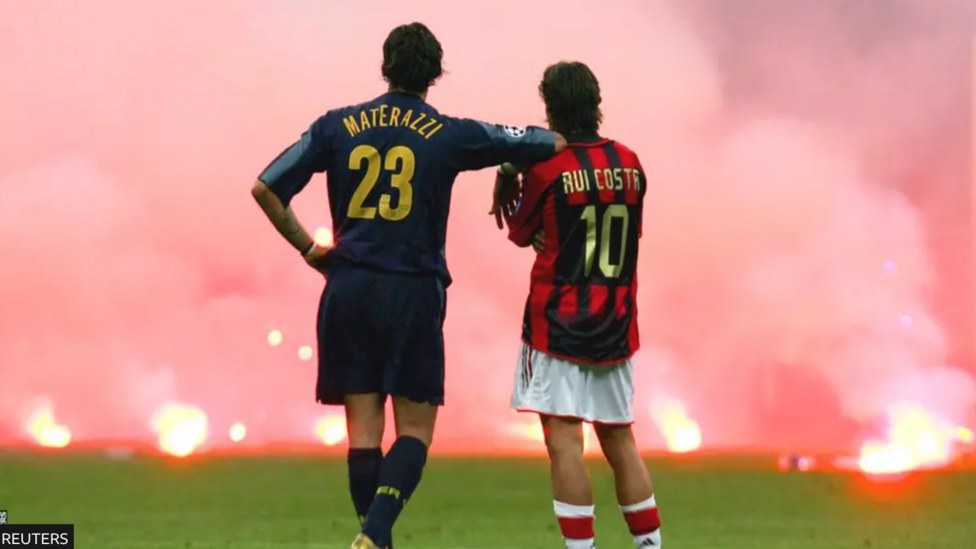
It is perhaps the most evocative photograph in the history of the Champions League. Amidst a thick, poisonous haze of crimson smoke and the glowing embers of falling flares, two men stand side-by-side in a moment of surreal tranquility. Marco Materazzi, the bruising Inter defender with a reputation for uncompromising physicality, rests an elbow on the shoulder of Rui Costa, the elegant Portuguese playmaker who represented the very soul of AC Milan’s creative flair. It was beauty and the beast, paused in a moment of shared disbelief as their world literally burned around them. This single frame, captured by photographer Stefano Rellandini, has become the definitive visual shorthand for the intensity and occasional madness of the Milan derby.
The image was born out of the chaos of the 2004-05 Champions League quarter-final second leg, a night that began with high sporting stakes and ended in a disciplinary nightmare. Inter were trailing their local rivals 3-0 on aggregate when the match was abandoned in the 73rd minute. The atmosphere at the San Siro had shifted from passionate to predatory, as a section of the Inter support unleashed a barrage of pyrotechnics onto the pitch. Rellandini, working for a major news agency at the time, recalls how the focus of most photographers was on the violence, but his eye was drawn to the center circle where two rivals had found a brief, strange common ground.
The Anatomy of a Powderkeg Atmosphere
To understand why the San Siro exploded that night, one must look at the psychological state of Milanese football in 2005. AC Milan, under the ownership of Silvio Berlusconi and the tactical guidance of Carlo Ancelotti, were in the midst of a golden era. They had won the Champions League in 2003 and entered the 2004-05 campaign as the reigning Italian champions. Their squad was a collection of legends: Maldini, Nesta, Cafu, and Stam formed a defensive line that felt impenetrable, while Kaka and Shevchenko provided the lethal edge. They were the benchmark of European excellence, a reality that sat uncomfortably with their neighbors.
Inter, by contrast, were the perennial bridesmaids of the era. Despite massive investment from chairman Massimo Moratti, who had broken transfer records for players like Ronaldo and Christian Vieri, the Nerazzurri were trapped in a cycle of underachievement. They were often mockingly referred to as 'August Champions' by rival fans, a nod to their tendency to build immense hype in the summer only to see their title ambitions evaporate by spring. The frustration in the Curva Nord was reaching a breaking point, fueled by a feeling that the domestic game was tipped in favor of a Milan and Juventus duopoly that always seemed to find a way to win.
The Tipping Point: Cambiasso's Disallowed Goal
The second leg of the quarter-final was already leaning heavily in Milan's favor thanks to a clinical strike from Andriy Shevchenko. Inter needed a miracle, and they thought they had found a spark when Esteban Cambiasso headed home from a Juan Sebastian Veron corner. It should have been the goal that offered a glimmer of hope, but referee Markus Merk ruled it out for a foul on Milan goalkeeper Dida. Replays suggested the contact was minimal, and the decision acted as a lightning rod for the fury simmering in the stands. It was the moment the sporting contest died and the riot began.
Within seconds, flares began to rain down from the upper tiers of the stadium. They weren't just the usual celebratory pyrotechnics; they were being used as projectiles. The San Siro, usually a temple of footballing excellence, was transformed into what Rellandini described as a war zone. The air became thick with sulfurous smoke, making it impossible for the players to see the ball or each other. As the referee attempted to manage the situation, the Inter ultras continued their barrage, signaling that they would rather see the game destroyed than witness another defeat to their bitterest rivals.
The Injury to Dida and the Abandonment
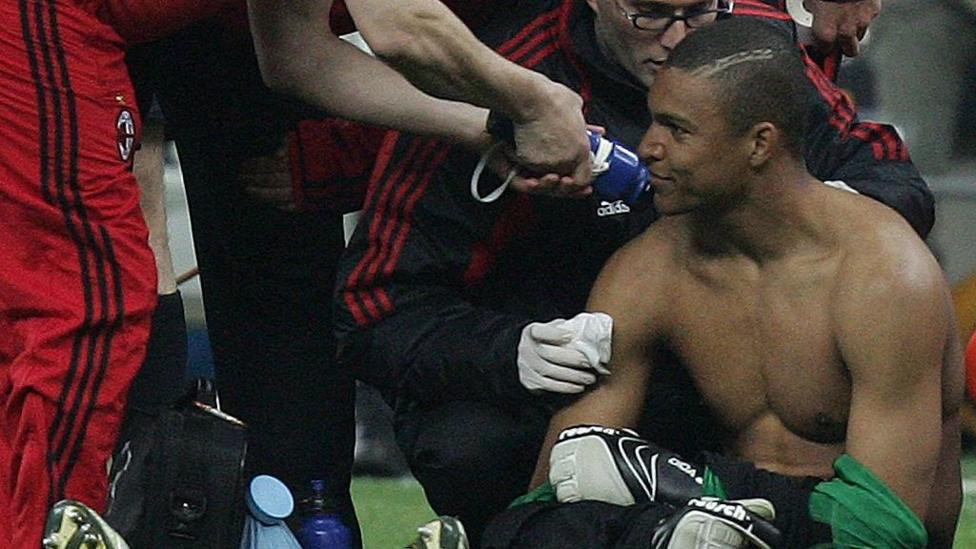
The most shocking moment of the night occurred when a flare struck Milan goalkeeper Dida directly on the shoulder. The Brazilian fell to the ground, smoke billowing from his jersey as he suffered first-degree burns. It was a graphic illustration of the danger present on the pitch. The players huddled in the center circle, attempting to shield themselves from the bottles and lighters that followed the flares. It was during this delay, as firefighters worked frantically to clear the debris and the referee deliberated on the tunnel's safety, that Materazzi and Rui Costa shared their famous moment.
Despite an attempt to restart the match after a 30-minute delay, the barrage resumed almost immediately. Christian Abbiati had replaced the injured Dida, but he had barely taken his position before more flares fell into the penalty area. Merk had no choice but to abandon the fixture. Ancelotti would later call it a 'disgraceful episode' that shamed the entire city of Milan. The match was eventually awarded as a 3-0 forfeit victory to Milan, but the scoreline was secondary to the sense of crisis that engulfed Italian football. The 'Derby della Madonnina' had crossed a line from which it would take years to fully recover.
A Galaxy of Stars Amidst the Debris
What makes the incident even more remarkable in hindsight is the sheer quality of the players caught in the crossfire. This was not a minor skirmish in a peripheral league; it was a clash of titans at the peak of their powers. The Milan lineup featured Kaka, Andrea Pirlo, and Clarence Seedorf—three of the finest midfielders to ever grace the game. Inter countered with the brilliance of Adriano and the tenacity of Javier Zanetti. Seeing these icons of the sport forced to flee into a tunnel for their own safety remains a jarring image for those who remember the era.
The squads represented the final flourish of a specific type of Italian footballing dominance. Inter’s midfield was a playground for Argentine technicality, while Milan’s back four was a masterclass in defensive positioning. Many of these players, including Materazzi and several members of the Milan squad, would go on to lift the World Cup for Italy just a year later. The flare incident was a dark stain on a period where the San Siro was effectively the center of the footballing universe. It proved that even the most sophisticated tactical battles could be derailed by the raw, unchecked emotion of the terrace.
The Shadow of Calciopoli and the Changing Tide
The fallout from the abandoned derby was swift and severe. UEFA handed Inter a massive fine and ordered them to play their next four European games behind closed doors. However, the true seismic shift was still to come. Just a year later, the Calciopoli scandal would break, revealing a web of influence and corruption that would see Juventus relegated and Milan docked points. Ironically, the vacuum left by these punishments allowed Inter to finally break their trophy drought, leading to a period of domestic dominance that culminated in Jose Mourinho’s treble in 2010.
The photograph of Rui Costa and Materazzi serves as a bridge between these eras. It captures the tension of the old hierarchy just before it was dismantled by scandal and the changing economics of the European game. Today, the image is sold in galleries and featured in documentaries, stripped of its original violent context and viewed instead as a poetic study of rivalry. It remains a reminder that in the heat of the most intense derbies, there is a shared humanity between the combatants that transcends the scoreline. The smoke has long since cleared, but the image remains as vivid as ever. more football news on MATCHLINE