Saudi Arabia's gritty draw with Uruguay suggests the billions poured into domestic transfers might finally be forging a more resilient national team.
The sweltering humidity of Miami provided the backdrop for a result that felt like a quiet declaration of intent. Saudi Arabia, often the whipping boys of World Cup opening fixtures, stood toe-to-toe with Uruguay, securing a 1-1 draw that was as much about tactical discipline as it was about individual brilliance. This was not the brittle side of decades past, but a cohesive unit that seemed to carry the streetwise confidence of a domestic league now populated by the elite of world football. As the final whistle blew, the conversation shifted from the sheer scale of investment in the Saudi Pro League to its tangible impact on the Green Falcons.
For years, the Saudi national team existed as a cautionary tale of a closed ecosystem. The squad was almost exclusively domestic-based, playing in a league that lacked the intensity of European competition. However, the landscape shifted dramatically when the sovereign wealth fund began funneling billions into the top four clubs. Suddenly, local players were sharing training pitches with Ballon d'Or winners and Champions League icons. The question was always whether these stars would stunt local growth or catalyze it. In Miami, the evidence leaned heavily toward the latter as the Saudi players exhibited a level of game-management rarely seen on this stage.
From Sapporo Scars to Miami Resilience
To understand the significance of the draw against Uruguay, one must look back at the historical trauma of 2002. In Japan, Saudi Arabia were dismantled 8-0 by Germany, a result that exposed the cavernous gap between Middle Eastern football and the global elite. It was a performance that defined the team for a generation - technically proficient in flashes but physically and mentally fragile when the pressure intensified. That night in Sapporo felt like it belonged to a different era entirely compared to the gritty, organized display seen this week.
The trajectory of the national team has been one of steady, calculated ascent. The victory over Mohamed Salah's Egypt in 2018 proved they could compete with regional rivals, but it was the earth-shattering defeat of Argentina in Qatar four years ago that truly changed the narrative. That win was no fluke; it was a blueprint. Against Uruguay, the Saudi players demonstrated that they have internalised the lessons of high-stakes football, refusing to be overawed by South American pedigree or the weight of expectation that comes with being the designated 2034 hosts.
The Pro League Greenhouse Effect
The presence of Cristiano Ronaldo, Karim Benzema, and Sadio Mane in the Saudi Pro League has created a high-pressure environment that serves as a daily bootcamp for the national squad. With the exception of Saud Abdulhamid, who recently made the leap to European football with Lens, every member of the starting XI against Uruguay plies their trade in the domestic top flight. They are no longer playing against journeymen; they are defending against Neymar and attempting to outmaneuver Riyad Mahrez every weekend.
This exposure has accelerated the development of younger talents who previously might have stagnated. When legends like Benzema speak about teaching young players what it takes to move to top clubs, it is not mere PR talk. The intensity of training sessions and the professional standards imported by these global icons have trickled down through the ranks. Local players have had to adapt or be left behind, and the result is a national pool that is physically fitter and tactically more sophisticated than any of its predecessors.
Tactical Discipline and Set-Piece Success
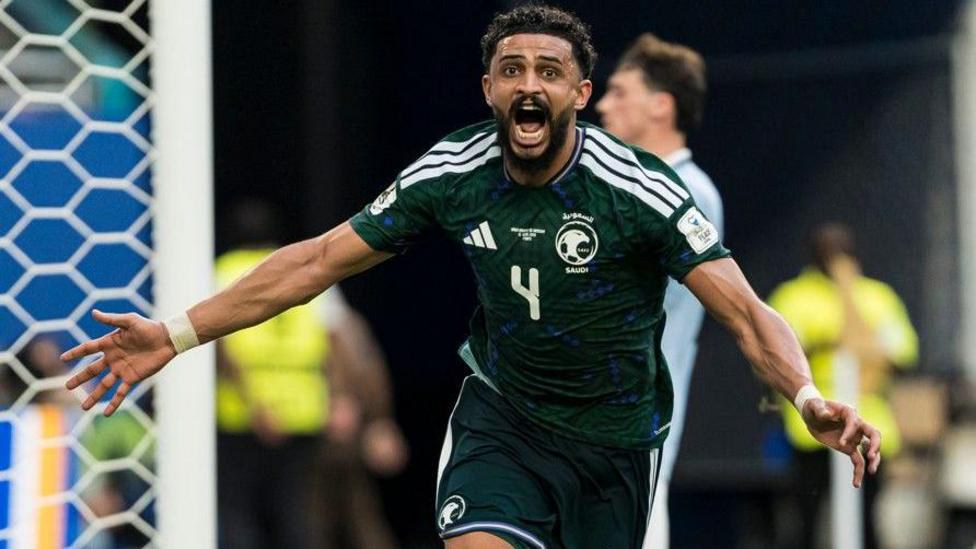
Defensively, the Green Falcons were a revelation against Uruguay. For 80 minutes, they restricted one of the world's most potent attacking units to speculative efforts, maintaining a rigid shape that drew praise from seasoned analysts. The distance between the lines was compact, and the communication across the back four suggested a level of coaching clarity that has often been missing. They were eventually breached by Maxi Araujo, but the disappointment in the Saudi camp afterward spoke volumes about their heightened expectations.
The offensive breakthrough was equally significant. Abdulelah al Amri, a regular teammate of Ronaldo at Al-Nassr, became the first defender in Saudi history to score at a World Cup. His goal, a towering header from a corner, was another milestone: the nation's first-ever goal from a set-piece in the competition. It highlighted a growing proficiency in the dark arts of the game, moving beyond the aesthetically pleasing but ultimately fruitless possession football that once characterized the team.
Transitioning Toward Youth and Sustainability
While the initial phase of Saudi football's expansion focused on veteran superstars, the strategy is evolving toward a more sustainable model. Recent windows have seen an emphasis on bringing in younger overseas players with potential sell-on value, a shift designed to ensure the league remains competitive without becoming a retirement home. This philosophy is reflected in the national team, where the 34-year-old captain Salem al Dawsari is now flanked by exciting prospects like 22-year-old playmaker Musab al Juwayr.
Al Juwayr, who led the team in assists during the qualifying campaign, represents the new face of Saudi football. He possesses the technical flair typical of the region but combines it with a modern work rate and tactical awareness. The goal is to produce more players like him who can eventually transition to European leagues, further enriching the national team's tactical variety. The interest in players like Mohamed Salah remains, but only if the financial and sporting parameters align with this new long-term vision.
The Donis Gamble and the Path Ahead
The decision to replace Herve Renard with Georgios Donis just two months before the tournament was viewed by many as an unnecessary gamble. Renard was the architect of the Argentina miracle, and his departure left a vacuum of leadership. However, Donis has quickly imposed a pragmatic style that suits the current squad's strengths. Against Uruguay, his fingerprints were all over the team's defensive cohesion and their ability to transition quickly from back to front.
As Saudi Arabia prepares for the remainder of the group stage, the focus will be on maintaining this level of consistency. The days of 8-0 thrashes appear to be firmly in the rearview mirror. With the 2034 World Cup on the horizon, the national team is no longer just a participant; they are a project in constant motion. The billions spent on the domestic league are not just buying stars - they are buying the expertise, intensity, and belief required to compete on the grandest stage of all. more football news on MATCHLINE